First Trip to China: What to Expect (A Practical Guide for Nordic Travellers)
Payments, apps, language, food, safety — everything a first-time visitor from Finland or the Nordics needs to know before landing in China, from someone who grew up there.
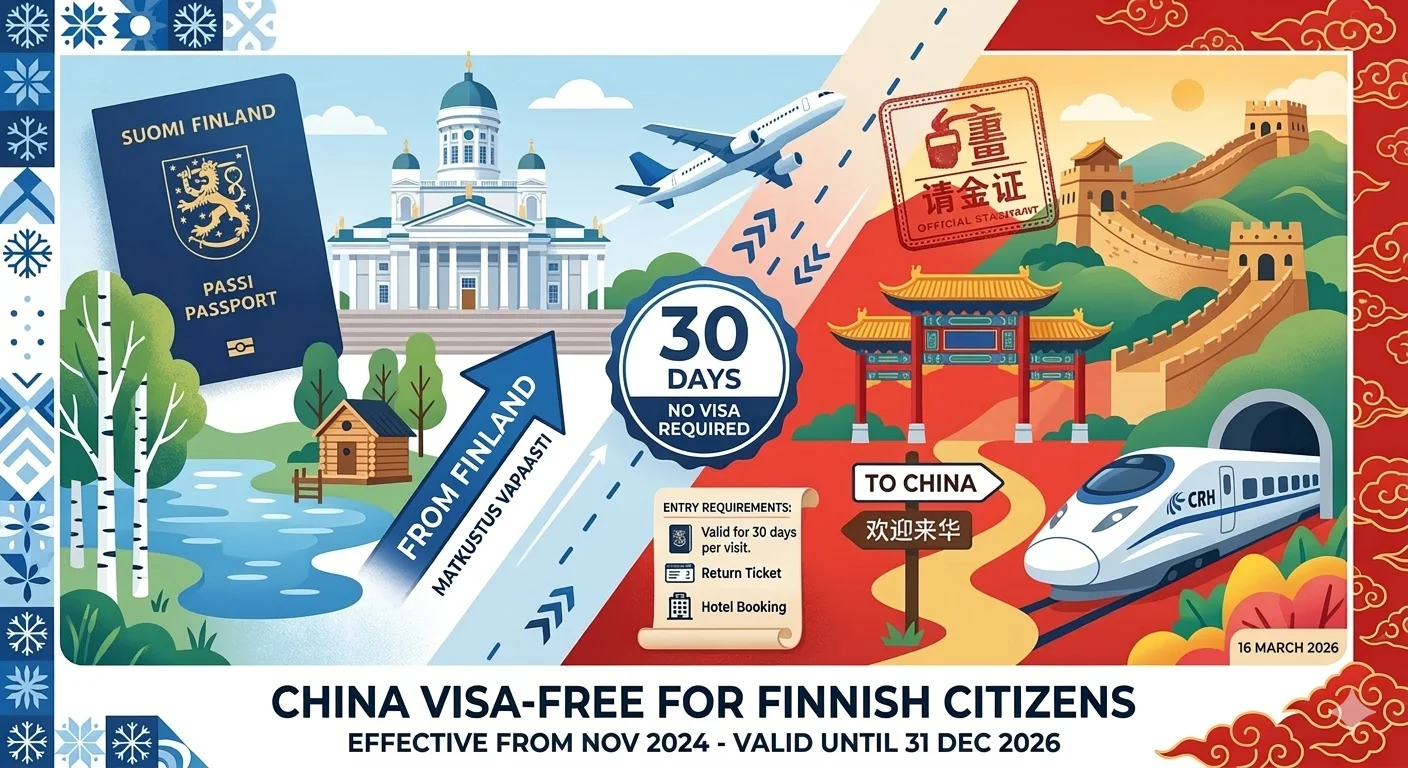
So you’re going to China. Maybe it’s the visa-free policy that tipped you over the edge (Finnish citizens can now enter visa-free for 30 days), or maybe you’ve been thinking about it for years. Either way — you’re in for something.
China is not what most people expect. It’s more modern than you think, more chaotic than you’re ready for, and more welcoming than the headlines suggest. I grew up there, lived 23 years of my life there, and now live in Finland. Here’s the honest, practical guide I wish I could hand every Nordic friend before their first flight to Shanghai or Beijing.
Before you go
Visa or visa-free? Check if your country is on China’s visa-free list. If you’re Finnish, you’re covered for up to 30 days. If not, apply at your nearest Chinese embassy — give yourself at least 3–4 weeks.
Travel insurance. Get it. Nordic public healthcare doesn’t cover you in China, and while Chinese hospitals are good (especially in big cities), you don’t want to deal with billing in Mandarin. Any standard travel insurance from your home country works fine.
Download these apps before you land:
- WeChat — messaging, payments, mini-programs. It’s the super-app that runs daily life in China. Set up an account before you go.
- Alipay — the other payment app. As a foreign tourist, you can now link an international credit card directly. Do this before your trip.
- Amap (高德地图) or Baidu Maps — Google Maps doesn’t work in China. These are accurate and have English interfaces.
- A translation app — Google Translate works offline if you download the Chinese package beforehand. Alternatively, try DeepL.
VPN. Let’s be straightforward: Google, Instagram, WhatsApp, YouTube, and most Western social media are blocked in China behind the Great Firewall. If you want to access them, you’ll need a VPN installed and configured before you arrive. Download one (or two, for backup) at home. Don’t expect to set this up after landing.
Arriving at the airport
Immigration is straightforward but can be slow during peak hours. You’ll fill out an arrival card, go through passport control, and in most airports have your fingerprints scanned. Have your hotel booking confirmation and return flight details accessible — officers occasionally ask for them.
SIM card or eSIM. You’ll want mobile data immediately. Options:
- Buy a tourist SIM card at the airport (China Mobile and China Unicom have counters). Bring your passport.
- Get a China eSIM before you travel — several providers sell them online. This is the easiest option if your phone supports it.
Data is cheap by Nordic standards. A week of unlimited data costs roughly the equivalent of a single coffee in Helsinki.
Money and payments
This will be your biggest culture shock. China is almost entirely cashless. People pay for everything — street food, taxis, vending machines, even busking tips — by scanning QR codes with their phones.
The good news: Alipay and WeChat Pay now accept foreign credit and debit cards. This was a huge barrier for tourists until recently. Link your Visa or Mastercard in the app before your trip, and you can pay almost everywhere locals do.
Carry a small amount of cash (a few hundred RMB) as backup. Some tiny shops, rural areas, or older vendors may not have QR codes. But in any city, your phone is your wallet.
ATMs exist and international cards (Visa, Mastercard) work at Bank of China and ICBC machines. But honestly, you may never need one.
Getting around
China’s transport infrastructure will impress you. Even coming from Finland, where things work well, the speed and scale are something else.
High-speed trains are the best way to travel between cities. The network covers most of the country, trains run frequently, and they’re clean, punctual, and fast — Beijing to Shanghai (1,300 km) takes about 4.5 hours. Book tickets through the China Railway 12306 app or through Trip.com, which has a better English interface. Book a few days ahead for popular routes, especially on weekends.
Metro systems exist in all major cities and are excellent — cheap, clean, well-signed in English and Chinese. Use Alipay’s transport QR code to tap in and out without buying tokens.
DiDi is China’s ride-hailing app (think Uber). It has an English interface and works well in cities. Cheaper than taxis and easier than negotiating with drivers if you don’t speak Mandarin.
Domestic flights are affordable but often delayed. If the distance is under 1,000 km, take the train instead — it’s faster door-to-door.
Language barrier
Here’s the thing: most Chinese people don’t speak much English. Even in Beijing and Shanghai, don’t assume that hotel staff, restaurant servers, or taxi drivers will understand you.
But don’t let this scare you. Signs in airports, train stations, and metros are bilingual (Chinese and English). Tourist sites have English signage. Restaurant menus in popular areas often have pictures or English translations.
Your translation app is your best friend. Point your camera at a menu, and it translates in real time. Type what you want to say and show the screen. People are patient with this and often find it fun.
A few phrases that go a long way:
- 你好 (nǐ hǎo) — Hello
- 谢谢 (xiè xie) — Thank you
- 多少钱 (duō shao qián) — How much?
- 不要 (bú yào) — I don’t want it (useful when street vendors are persistent)
- 厕所在哪里 (cè suǒ zài nǎ lǐ) — Where’s the toilet?
You don’t need to be fluent. A smile, a translation app, and basic gestures will get you through 99% of situations.
Food and dining
You’re going to eat incredibly well. Chinese food in China has almost nothing in common with Chinese restaurants in Helsinki. It’s more varied, more flavourful, and far cheaper than you expect.
How ordering works: In many restaurants, especially chains and newer places, you’ll scan a QR code at your table, browse the menu on your phone, and pay — all without talking to anyone. This is actually great when you don’t speak the language, because there are usually pictures. In smaller or older restaurants, just point at what you want on the menu or at what other tables are eating.
Tipping: Don’t. It’s not expected and can even cause confusion. The price on the menu is what you pay.
Chopsticks: You’ll need to use them. Forks are rare outside of Western restaurants. If you’re not confident, practise a bit before your trip. No one will judge you for being clumsy — they’ll appreciate that you’re trying.
Water: do not drink from the tap. This is important. Tap water in China is not safe to drink directly — even locals don’t drink it unboiled. Every hotel room will have a kettle and complimentary bottled water. Buy bottled water from any convenience store (it costs almost nothing). In restaurants, you’ll be served boiled water or tea — both are fine.
Street food is one of the great joys of China. It’s generally safe in busy areas with high turnover. Follow the crowds — if a stall has a queue of locals, it’s good. Don’t miss Chinese breakfast — an entirely outdoor, street-level eating culture that’s nothing like mornings in the Nordics. And if you’re headed to Sichuan, hot pot is essential.
Internet and apps
The Great Firewall is real. Without a VPN, you cannot access Google (including Gmail and Maps), Facebook, Instagram, WhatsApp, YouTube, Twitter/X, or most Western news sites. If staying connected to these matters to you, set up a VPN before your trip.
What works without a VPN: WeChat, Alipay, Apple services (iCloud, iMessage, FaceTime), Bing, Outlook, most banking apps, Spotify (usually), and Signal (intermittently).
Essential apps recap:
| App | What it does |
|---|---|
| Messaging, payments, mini-programs — it’s everything | |
| Alipay | Payments, transport QR codes |
| Amap / Baidu Maps | Navigation (Google Maps won’t work) |
| DiDi | Ride-hailing |
| Trip.com | Train and flight bookings in English |
| 12306 | Official railway booking (Chinese interface) |
WiFi is available in most hotels, cafes, and shopping malls. Quality varies. Your mobile data plan is more reliable.
Culture shocks for Nordics
Coming from Finland, certain things will hit you immediately.
Personal space doesn’t exist. The Finnish two-metre bubble? Forget it. People will stand close to you in queues, squeeze past you on sidewalks, and pack into trains. It’s not rude — it’s just how a country of 1.4 billion people operates. You’ll adjust faster than you think.
It’s loud. Restaurants are noisy. Streets are noisy. People talk on speakerphone in public. Markets shout. If you need quiet, bring good earphones. This isn’t chaos — it’s energy. After a few days, the silence of Finland will feel strange.
Squat toilets still exist — especially in older buildings, train stations, and rural areas. Most shopping malls, hotels, and airports have Western-style toilets. Carry tissues with you; not every public toilet provides them. Many now have both options, and things are improving fast.
Staring. If you look visibly foreign — especially outside of Beijing and Shanghai — people will stare. Some will want photos with you. This is curiosity, not hostility. In smaller cities and towns, a blond-haired Nordic person is genuinely unusual. Smile, take the selfie, move on.
The people
This might be the most important section. Chinese people are, overwhelmingly, friendly and genuinely willing to help foreigners. This is something that surprises almost every first-time visitor.
If you look lost at a train station, someone will come to help — often pulling out their phone to translate. If you’re struggling to order food, the person next to you will start pointing at good dishes on the menu. If you compliment someone’s city, they’ll beam with pride and start recommending places to visit.
As a visitor from Europe, you’ll find people especially warm and curious. They’ll ask where you’re from, what you think of China, whether you’ve tried the local food. It’s genuine interest, not an act.
This helpfulness extends to the practical as well. If you ever find yourself in trouble — lost, scammed, or in any kind of difficult situation — don’t hesitate to contact the police. China takes the safety of foreign visitors seriously. Police are responsive and will go out of their way to help tourists resolve issues. You’ll find police stations (派出所, pàichūsuǒ) in every neighbourhood, and officers in tourist areas sometimes speak basic English.
Emergency numbers:
- 110 — Police
- 120 — Ambulance
- 119 — Fire
Safety
China is one of the safest countries in the world for tourists. Violent crime against foreigners is extremely rare. Petty theft exists but is far less common than in most European cities. You can walk alone at night in virtually any Chinese city without worry.
Scams are the main thing to watch for — particularly in heavy tourist areas. The most common: strangers who speak excellent English approach you, suggest visiting a “tea house” or “art gallery,” and you end up with a massive bill. Rule of thumb: if someone approaches you on the street with suspiciously good English and a friendly invitation, politely decline.
Traffic. This is the real safety concern. Pedestrians do not have the right of way in practice, regardless of what the traffic lights say. Cars, electric scooters, and bikes share the road in a way that feels anarchic. Look both ways — always — even on one-way streets. Electric scooters are silent and fast, and they ride everywhere, including on sidewalks.
Food safety is generally good, especially in restaurants and established street food stalls. Avoid raw or undercooked food from questionable sources. Stick to busy places with high turnover.
What most guides won’t tell you
The convenience will ruin you. Within a day, you’ll be ordering food delivery to your hotel, paying for everything with your phone, and taking high-speed trains between cities without printing a single ticket. Going back to tapping a physical card on a Helsinki bus will feel quaint.
China moves fast. The city you see today may look different next year. New metro lines, new buildings, new apps. The pace of change is something you have to experience to understand.
You will eat better than you ever have. I’m not exaggerating. The regional variety is staggering — Sichuan spice, Cantonese dim sum, Xinjiang lamb, Yunnan mushrooms, Shanghai soup dumplings. Budget at least one meal per day to just wander and discover. (Start with our twice-cooked pork guide if you want a taste of Sichuan before you go.)
People will be kinder than you expect. This is the thing that stays with every visitor I’ve talked to. Beneath all the noise and crowds and alien-looking characters, there are people who will go out of their way to help a stranger. That’s China.
Ready to plan your trip? Check if you qualify for visa-free entry, figure out the best time to go, and if Sichuan is on your list, start with Chengdu.