Twice-Cooked Pork (回锅肉): The Dish Every Sichuan Family Grows Up With
Twice-cooked pork isn't fancy. It's the dish Sichuan grandmothers make on weekdays — and it's one of the greatest things you'll ever eat. Here's the real story behind huíguōròu.
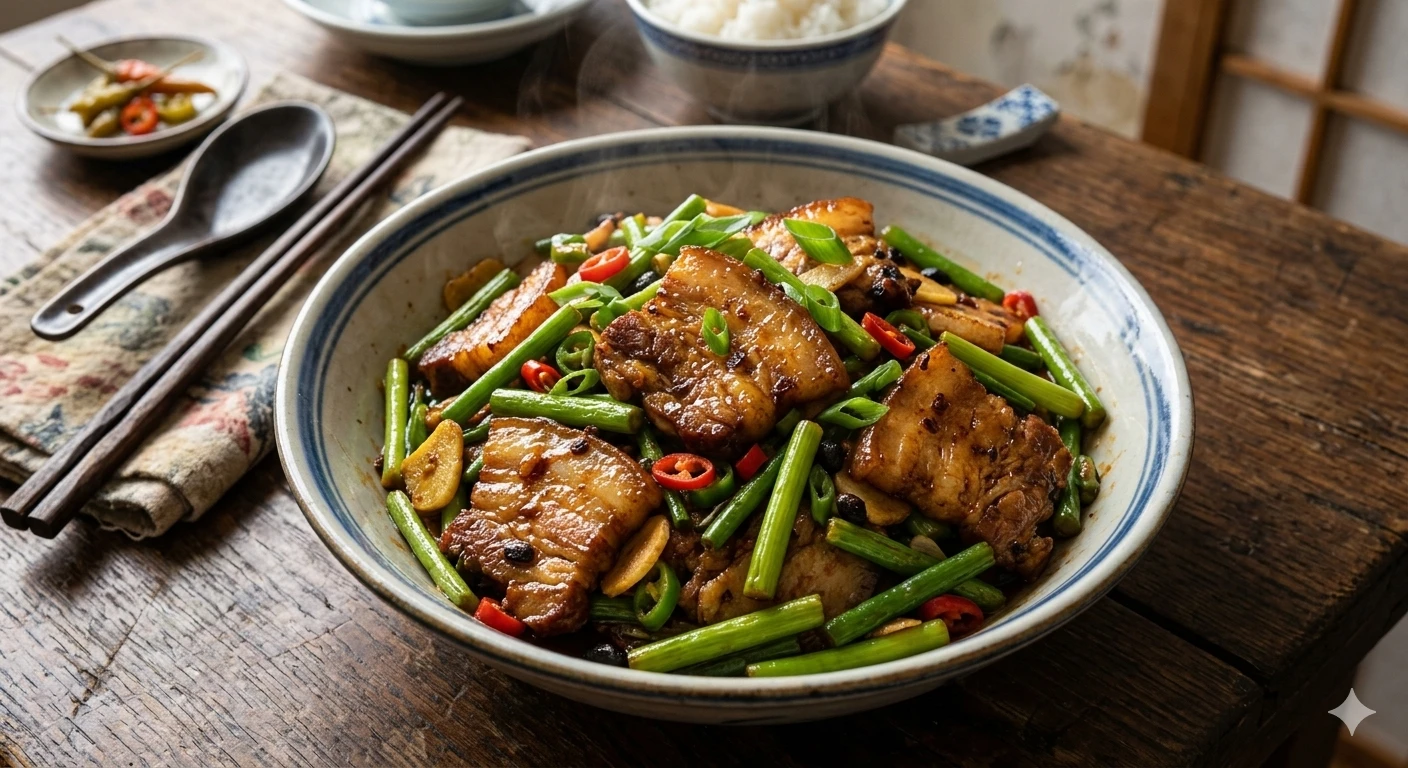
If you ask a person from Sichuan to name the single dish that represents home, most won’t say hotpot. They won’t say mapo tofu. They’ll say 回锅肉 (huíguōròu) — twice-cooked pork. It’s the dish their mother made on a Tuesday evening. The dish their grandfather demanded at every family dinner. The dish that, if you get it right, needs nothing else on the table except a bowl of rice.
I’ve eaten this dish hundreds of times. At family tables, at roadside restaurants in Chengdu, at canteens where construction workers line up at lunch. It is never the same twice, and yet it’s always recognisably itself. That’s the beauty of it.
What “twice-cooked” actually means
The name is literal. The pork is cooked twice: first boiled whole, then sliced and stir-fried. This double cooking is the entire secret. Boiling renders out excess fat and firms up the meat. Stir-frying then crisps the edges and lets the pork absorb the sauce. The result is slices that are tender inside, slightly caramelised outside, and soaked through with flavour.
In Chinese, 回锅 (huíguō) means “return to the pot.” The pork leaves the pot, rests, gets sliced — then goes back in. Simple concept, extraordinary result.
The real version vs. what you get abroad
Let me be direct: most “twice-cooked pork” served outside China is not twice-cooked pork. It’s stir-fried sliced pork in a vaguely sweet-spicy sauce. It’s fine. But it’s not this.
The authentic version depends on three things that are hard to find abroad:
郫县豆瓣酱 (Pixian doubanjiang) — This is the soul of the dish. It’s a fermented chili bean paste from Pixian, a district near Chengdu. It’s aged for at least a year, sometimes three. It tastes nothing like the generic “chili bean paste” you find in most Asian grocery stores. If you can find the real thing — look for a jar that says 郫县 on it — buy it. It will transform your cooking.
蒜苗 (suànmiáo) — garlic sprouts — Not garlic chives, not spring onions, not leeks. Garlic sprouts are the green shoots of the garlic plant, thicker than chives, with a distinct garlicky bite. This is the traditional vegetable pairing. In many versions outside Sichuan, leeks (大蒜) or green peppers substitute — acceptable, but different.
五花肉 (wǔhuāròu) — pork belly — Specifically a piece with clear, even layers of fat and lean meat. The fat is not optional. When sliced thin and fried, the fat renders and the edges curl up slightly — what Sichuan cooks call “灯盏窝” (lamp-bowl shape). If your pork slices curl, you’re doing it right.
How it’s made at home
Every Sichuan household has their own variation, but the bones are always the same:
Start with a whole piece of pork belly, skin on. Boil it in water with ginger and Sichuan peppercorns until just cooked through — about 20 minutes. Don’t overcook it; you want it firm enough to slice cleanly. Take it out, let it cool until you can handle it, then slice it thin — about 3mm. Thinner crisps better, thicker stays more tender.
Heat the wok until it smokes. Add the pork slices with no oil — the fat in the pork is enough. Fry until the edges go golden and the slices start curling. Push them to the side. Drop in a generous spoonful of Pixian doubanjiang and fry it in the rendered pork fat until the oil turns red and fragrant. Add a small spoon of fermented black beans (豆豉) if you have them. Some families add a splash of sweet wheat paste (甜面酱) for depth.
Toss everything together. Add the garlic sprouts — cut into 4cm pieces — and stir-fry for just 30 seconds. They should stay bright green and slightly crunchy. A tiny splash of soy sauce for colour, and you’re done.
The whole stir-fry takes about three minutes. The prep took twenty. That’s Chinese home cooking in a nutshell — patience in preparation, speed in execution.
Why it matters
Twice-cooked pork is not a restaurant showpiece. You won’t find it on the cover of food magazines or trending on social media. It’s the kind of food that exists because ordinary people, over generations, figured out how to make something extraordinary from a cheap cut of pork and a jar of fermented paste.
In Sichuan, food culture isn’t about luxury. It’s about flavour, ingenuity, and the daily ritual of eating well without spending much. Twice-cooked pork is the purest expression of that philosophy. It costs almost nothing to make. It takes no special skill. And when it’s done right — the pork glistening, the doubanjiang fragrant, the garlic sprouts still snapping between your teeth — it’s as good as food gets.
If you visit Chengdu, order it at any small restaurant that has 家常菜 (jiācháng cài — home-style cooking) on the sign. Don’t go to a fancy place. Go where the tables are sticky and the wok hasn’t cooled down since morning. That’s where you’ll find the real thing.
Finding the ingredients in Finland
For readers in Finland and the Nordics, here’s where to look:
Pixian doubanjiang is available at most Asian supermarkets in Helsinki — try the stores around Hakaniemi or Sörnäinen. The brand “Juan Cheng” (鹃城) with a red label is the most authentic widely available one. Online, you can order from Asian food shops that ship within the EU.
Pork belly (possunkyljys in Finnish) is easy to find at any supermarket. Ask at the meat counter for a whole piece rather than pre-sliced.
Garlic sprouts are harder. Chinese supermarkets sometimes stock them, but availability is seasonal. Green leeks (purjosipuli) or young garlic chives are your best substitutes.