Hot Pot: A Beginner's Guide to China's Greatest Communal Meal
How hot pot works, what to order, how to build your dipping sauce, and what nobody tells you — from someone who spent a year eating it in Chengdu.
Hot pot is not a dish. It’s an event.
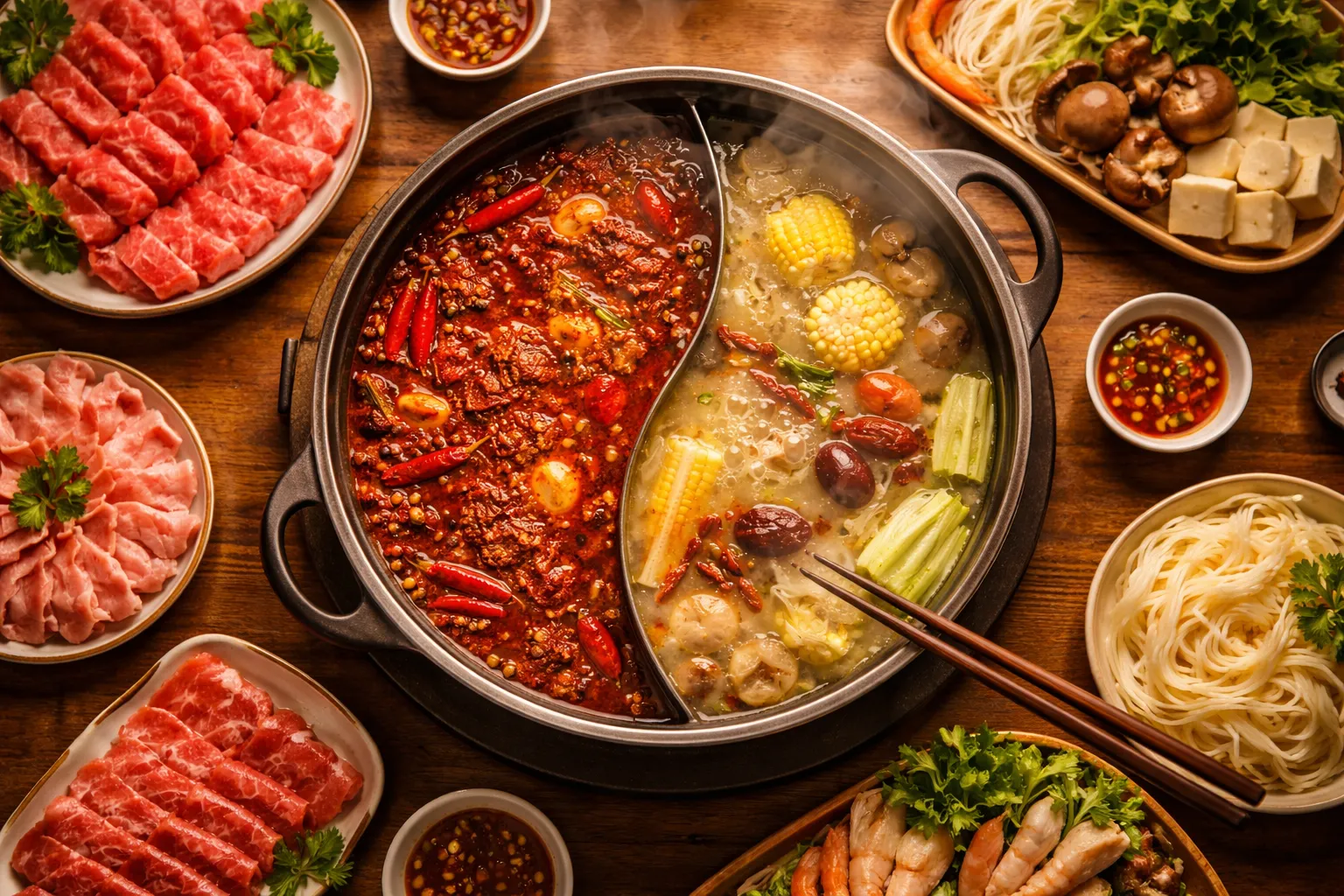
A pot of boiling broth sits in the middle of the table. Around it: plates of thinly sliced meat, vegetables, tofu, mushrooms, noodles, and things you may not recognize. You pick up raw ingredients with your chopsticks, drop them into the bubbling broth, wait, fish them out, dip them in your personal sauce bowl, and eat. Repeat for the next two hours.
It’s loud. It’s messy. The steam fogs your glasses. Your clothes will smell like it for days. And it is, without exaggeration, one of the best meals you will ever have.
I spent a year living and working in Chengdu — the heart of Sichuan province and the spiritual capital of hot pot. I ate it at least once a week, often more. It became the meal I associated with friendship, with weekends, with celebration and comfort equally. Here’s everything you need to know before your first pot.
How it works
The concept is simple. You sit down at a table with a built-in burner or induction plate. You choose a broth. You order raw ingredients. The broth boils, you cook the food in it yourself, and you eat it with dipping sauce.
That’s it. No chef, no kitchen magic — just you, the pot, and your friends. The beauty of hot pot is that it’s interactive. Everyone participates. Everyone eats at their own pace. And the conversation never stops because the meal never really has a defined beginning or end.
A typical hot pot dinner lasts 1.5 to 2 hours. Nobody rushes.
Choosing your broth (锅底)
This is the first and most important decision. The broth is the soul of the meal — everything you cook will absorb its flavour.
Spicy Sichuan (麻辣锅) — The classic. A deep red broth loaded with chili peppers, Sichuan peppercorns, and chili oil. It’s not just hot — it’s má là, meaning both numbing and spicy. The Sichuan peppercorn creates a tingling, buzzing sensation on your lips that’s unlike anything in European cuisine. If you’ve never experienced it, start cautiously. It builds.
Mild bone broth (清汤锅) — A clear, gentle broth made from pork or chicken bones, often with jujube dates, goji berries, and ginger. Subtle, clean, and lets the ingredients speak for themselves. This is your safe choice if you don’t eat spicy food.
Tomato broth (番茄锅) — Sweet, tangy, and mild. Popular with families and anyone who wants flavour without heat. A good middle ground.
Mushroom broth (菌汤锅) — Earthy, umami-rich, made from a mix of dried mushrooms. Popular in Yunnan-style hot pot restaurants.
The smart move: get a split pot (鸳鸯锅). This is a divided pot — literally half spicy, half mild — so everyone at the table is happy. It’s called “yuanyang” (mandarin duck pot), named after the ducks that always swim in pairs. If your group has mixed spice tolerance (and it will), order this. No shame in it — locals do it all the time.
What to order
Hot pot menus can be overwhelming — dozens of items across multiple categories. Here’s how to navigate it.
Start with these (the essentials):
- Thinly sliced lamb (羊肉卷) or beef (肥牛) — The stars of any hot pot. Paper-thin slices that cook in seconds. Order at least two plates for the table.
- Tofu (豆腐) — Fresh tofu, frozen tofu (which has a spongy texture that soaks up broth beautifully), or tofu skin (豆腐皮).
- Leafy greens — Lettuce, spinach, crown daisy (茼蒿), or Chinese cabbage. They cook fast and balance out the richness.
- Mushrooms — Enoki, king oyster, shiitake. They absorb the broth and develop incredible flavour.
- Potato slices (土豆片) — Thin-sliced, they cook quickly and are universally loved. A crowd-pleaser.
- Noodles or rice cakes — Add these toward the end. Wide sweet potato noodles (红薯粉) are a Sichuan classic — slippery, chewy, and they soak up the spicy broth.
For the adventurous:
- Tripe (毛肚) — The single most popular hot pot ingredient in Sichuan. Thin sheets of beef stomach that you swish in the boiling broth for exactly 15 seconds — no more, or it turns rubbery. Locals judge a hot pot restaurant by its tripe.
- Duck blood (鸭血) — Soft, dark cubes with a silky, tofu-like texture. Milder than it sounds. A Chengdu staple.
- Brain (脑花) — Yes, pig brain. Creamy, rich, and honestly delicious if you don’t think about it too hard. Wrapped in foil and slow-cooked in the spicy broth. Very Sichuan.
- Luncheon meat (午餐肉) — Spam-like sliced meat. Not traditional, but wildly popular. Don’t judge until you’ve tried it simmered in má là broth.
How much to order: For a group of 3–4 people, start with 4–5 meat plates, 3–4 vegetable dishes, one tofu, one mushroom, and noodles for the end. You can always add more — the kitchen keeps taking orders throughout the meal.
The dipping sauce station
This is where beginners get completely lost — and where regulars have their own ritual perfected to an art.
Most hot pot restaurants have a DIY sauce bar: a counter lined with 15–20 small containers of different sauces, oils, and toppings. You grab a small bowl and mix your own.
Starter recipe (works every time):
- A generous base of sesame paste (芝麻酱)
- Minced garlic (蒜泥) — lots of it
- Chopped cilantro (香菜)
- A splash of soy sauce
- A drizzle of sesame oil
- Chili oil if you want extra heat
That’s your foundation. From there, experiment: add oyster sauce for sweetness, vinegar for tang, fermented tofu (腐乳) for funk, or chopped scallions for freshness.
In Sichuan, the traditional dipping sauce is much simpler — just sesame oil with garlic. The logic is that the broth is already so flavourful, you just need something smooth to cool and coat the food. Try it. It works.
The sauce bar is usually free or costs a flat fee (5–10 RMB) regardless of how many bowls you fill. Take advantage of it.
Cooking tips
Hot pot looks simple, but a few principles will dramatically improve your experience.
Know your cooking times:
| Ingredient | Time in broth |
|---|---|
| Thin-sliced meat | 10–20 seconds (until colour changes) |
| Leafy greens | 15–30 seconds |
| Tripe | 15 seconds (the “seven up, eight down” rule — swish it) |
| Mushrooms | 2–3 minutes |
| Tofu | 3–5 minutes |
| Potato slices | 2–3 minutes |
| Meatballs | 4–5 minutes (until they float) |
| Noodles | 3–5 minutes |
| Corn on the cob | 8–10 minutes |
Don’t dump everything in at once. The broth temperature drops with each addition, and flavours get muddled. Cook in batches — a few slices of meat, eat them, then some vegetables, eat those. Pace it.
Use the right chopsticks. Most restaurants provide longer serving chopsticks for cooking and shorter ones for eating. Use the long ones to handle food in the boiling broth — it’s safer and more hygienic.
Fish things out on time. Leafy greens turn to mush if forgotten. Meat overcooks in seconds. If you lost a meatball in the bubbling depths, the slotted spoon (漏勺) is your rescue tool.
Save noodles and starchy items for the end. By then the broth has absorbed the flavour of everything you’ve cooked — it’s at its richest. Noodles and rice cakes dropped in at the end are unbelievably good.
Regional styles
Hot pot exists across all of China, but the styles vary dramatically.
Sichuan (川味火锅) — The most famous. Fiery red broth, heavy on chili and Sichuan peppercorn. Butter-based in Chengdu, oil-based in Chongqing. Intense, bold, unforgettable. This is what most people picture when they think of Chinese hot pot.
Beijing copper pot (铜锅涮肉) — A tall, charcoal-heated copper pot with a chimney in the centre. The broth is simple — just water with ginger and scallions. The focus is on the ingredients, especially thin-sliced lamb. Dipping sauce is sesame paste-based. Elegant, traditional, and completely different from the Sichuan experience.
Cantonese (粤式火锅) — Lighter broths, premium seafood, and delicate ingredients. Less about overwhelming spice, more about clean, natural flavours. Popular with fresh fish, shrimp, and shellfish.
Yunnan mushroom hot pot (云南菌子火锅) — A pot loaded with wild mushrooms in an earthy, umami-packed broth. Some of these mushrooms are genuinely rare and seasonal. If you visit Yunnan, this is unmissable.
Haidilao (海底捞) — Not a regional style, but a chain so famous it deserves mention. Haidilao is the world’s largest hot pot chain, known more for its absurd level of service than its food. Free manicures while you wait. Staff who perform noodle-pulling dances at your table. Birthday celebrations that will embarrass you in front of the entire restaurant. The hot pot is solid, and they have English menus and picture ordering — making it the easiest first hot pot experience for tourists.
Hot pot etiquette
Hot pot is communal and casual. There’s no formality here. But a few unwritten rules:
Share everything. All the dishes go in the middle. You don’t order “your own” plate of meat — everything is for the table.
Use the serving chopsticks for putting raw food into the pot, and your personal chopsticks for eating. This is a hygiene thing, and people notice.
Don’t hog the prime cooking spots. The centre of the pot is the hottest — that’s where meat cooks fastest. Take turns.
Pace yourself. It’s a marathon, not a sprint. If you attack the meat in the first 20 minutes, you’ll be full before the best part (noodles at the end).
Drink beer or herbal tea, not wine. Hot pot and cold beer are inseparable in China. Herbal teas like wang lao ji (王老吉) — a sweet, slightly medicinal drink — are the traditional pairing, believed to balance the internal “heat” from all that spice. Wine doesn’t work here. Don’t try.
Splatter is normal. The bubbling broth will splash. Wear something you don’t mind smelling like hot pot for the next 24 hours. Some restaurants offer aprons and phone bags — use them.
Taking it home
Here’s something I didn’t know was possible until I moved to Chengdu.
I was sharing a three-bedroom apartment with a colleague — a Sichuanese local. After one of our first hot pot dinners together, I started gathering my things to leave the restaurant. He looked at me, confused, and asked the server to pack up the remaining broth and raw ingredients. All of it. The pot of broth went into containers. The uncooked meat and vegetables went into bags. We carried it all home.
The next morning, he reheated the broth on our kitchen stove, and we had hot pot again — for breakfast. The broth was even better the second time around, deeper and more concentrated after a night in the fridge.
In Sichuan, this is completely normal. Hot pot is expensive enough that you don’t waste good broth and leftover ingredients. Restaurants are used to the request and will pack everything up without blinking.
Outside of Sichuan, this is less common, and you might get some puzzled looks. But in Chengdu? Just ask. They’ll hand you bags and containers like it’s the most natural thing in the world.
Where to go as a tourist
Your first time: go to Haidilao. I know, I know — it’s a chain. But for your first hot pot, the English menus, picture ordering, attentive service, and consistent quality make it the right choice. You can focus on learning how hot pot works without also struggling to order in Chinese. Haidilao restaurants are in every major Chinese city.
Your second time: go local. Ask your hotel staff, ask a taxi driver, ask anyone: “哪里的火锅好吃?” (nǎ lǐ de huǒ guō hǎo chī — where’s good hot pot?). The best hot pot is in small, loud, packed restaurants where the tables are sticky and the broth recipe hasn’t changed in decades. In Chengdu, these are on every other street.
Budget: Hot pot is surprisingly affordable. A full dinner for 3–4 people with plenty of meat, vegetables, drinks, and dipping sauce typically runs 150–300 RMB total (€20–40). Split between friends, it’s one of the cheapest ways to have an incredible meal in China.
Ordering without Chinese: Most hot pot restaurants have picture menus. Point at what looks good. If there’s a QR code menu on the table, use your phone’s translation app to scan it. At sauce bars, just watch what locals are putting in their bowls and copy them — they know what they’re doing.
Why hot pot matters
I want to end with something that goes beyond the food.
In China, hot pot is how people connect. It’s the default meal for catching up with old friends, welcoming new colleagues, celebrating birthdays, or just filling a cold winter evening. You can’t eat hot pot alone — well, you can, but it misses the point.
There’s something about sitting around a shared pot, cooking your own food, passing dishes across the table, arguing about whether the meatballs are done — it creates a kind of intimacy that ordered-and-served meals don’t. The meal slows down. Conversation fills the gaps between bites. Two hours pass without anyone noticing.
In Finland, the closest thing might be a long dinner party at someone’s home. But hot pot has an ease to it — no one needs to cook in advance, no one does dishes, and the restaurant handles everything except the eating. All you bring is yourself and an appetite.
If you only eat one meal in China, make it hot pot. Preferably in Chengdu. Preferably with friends. And preferably with a split pot, because you think you can handle the full spicy, but trust me — start with half.
Planning a trip to Sichuan? Read our Chengdu city guide and check out Sichuan’s other famous dish — twice-cooked pork. And if this is your first visit to China, our practical first-trip guide covers everything from payments to transport.