
Best Time to Visit China: A Season-by-Season Guide
Spring cherry blossoms or winter ice festivals? Monsoon season or golden autumn? Here's when to visit China depending on what you want to see — from someone who's lived through all four seasons.
China is enormous — roughly the same latitude range as from North Africa to Scandinavia. That means there’s no single “best time” to visit. Beijing in January is bitterly cold. Hainan in January is beach weather. Chengdu is mild year-round. Xinjiang has desert summers and arctic winters.
But if you’re planning your first trip and want a general answer: April–May and September–October are the sweet spots. Here’s why — and when to break that rule. (And if you haven’t checked yet, see whether you qualify for China’s visa-free entry — 50 countries are now on the list.)
Spring (April–May) — fresh, green, and uncrowded
Spring is when China shakes off winter. Temperatures across most of the country sit between 10–25°C, the air is relatively clear, and everything is green. It’s my favourite season for travel in China — the energy just feels right.
Beijing is perfect in late April and May. The Great Wall is walkable without sweating or freezing. Hangzhou’s West Lake is at its most photogenic. If you time it right, you can catch the famous peony festival in Luoyang (mid-April), where the city goes completely mad for flowers.

Southern China — Guilin, Yunnan, Fujian — is lush and warm but not yet humid. It’s the window before the monsoon arrives.
One warning: avoid the Labour Day holiday (around May 1). It’s a week-long national holiday, and domestic travel explodes. Prices spike, trains sell out, and popular sites get overwhelmed. Aim for mid-April or mid-to-late May instead.
Summer (June–August) — hot, wet, but worth it in the right places
Summer is polarising. Cities like Nanjing, Wuhan, and Chongqing — the so-called “three furnaces” — regularly hit 35–38°C with suffocating humidity. Shanghai isn’t much better. If your idea of a good time doesn’t include being drenched in sweat walking between air-conditioned spaces, avoid eastern lowland cities in July and August.
But summer is the best time for highlands and mountains. Yunnan province — Kunming, Dali, Lijiang — stays cool and pleasant, typically 18–25°C. Tibet is most accessible in summer, with warm days, tolerable nights, and the roads in good condition. Qinghai Lake, Zhangjiajie, and the grasslands of Inner Mongolia are all at their best.

Southern China gets heavy monsoon rain from June onward, which means dramatic landscapes — terraced rice paddies flooded and luminous green — but also the risk of travel disruptions. Flights and trains can be delayed; mountain roads can close.
Summer is also peak season for domestic tourism because of school holidays. Budget accordingly.
Autumn (September–October) — the golden season
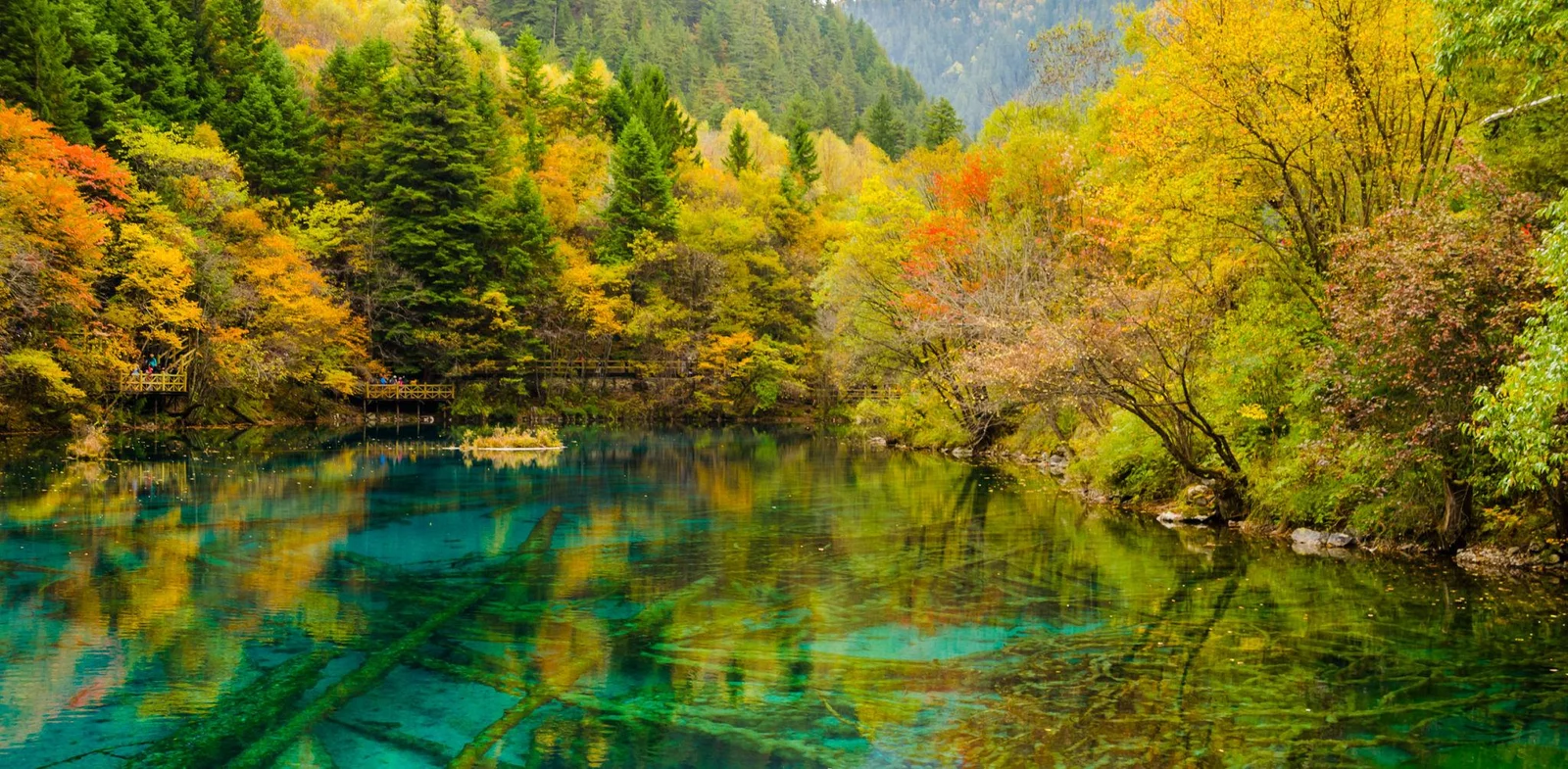
If I had to pick one month to send someone to China for the first time, it would be October (but not the first week — I’ll explain).
Autumn is magnificent. The heat breaks, humidity drops, and the sky turns that deep, clear blue that Beijing is famous for in this season. Temperatures hover around 15–25°C across most of the country. The colours are extraordinary — especially in mountain areas.
Jiuzhaigou Valley in Sichuan is legendary in autumn. The turquoise lakes surrounded by blazing red and gold forests are unlike anything else. The Great Wall is dramatic with foliage. Shanghai is finally comfortable for walking. And nearby Chengdu — Sichuan’s capital — is perfect for combining autumn scenery with incredible food.
The catch: China’s National Day holiday runs from October 1–7, and it is by far the busiest travel week of the year. Hundreds of millions of people travel domestically. Trains, flights, and hotels are booked solid weeks in advance, and popular scenic spots become genuinely unpleasant. If at all possible, visit in mid-September or after October 8. The weather is just as good, and you’ll have a completely different experience.
Winter (November–March) — quiet, cheap, and surprisingly rewarding
Winter scares most tourists away from China, and that’s exactly why it can be the best time to go — if you choose your destinations wisely.
Northern China is genuinely cold. Beijing in January averages around −5°C, and cities in the northeast like Harbin drop to −20°C or below. But Harbin is also home to the Harbin International Ice and Snow Festival (January–February), one of the most spectacular winter events in the world — enormous ice sculptures lit up in neon colours across the city.

Southern China, meanwhile, stays mild through winter. Kunming (“Spring City”) averages 8–17°C year-round. Hong Kong and Guangzhou are pleasant in December and January. Hainan Island — China’s tropical south — is genuine beach weather in winter, with temperatures around 20–25°C.
Winter is also the cheapest time to fly to China and book hotels. The major sites — the Forbidden City, the Terracotta Warriors, the Great Wall — are all open, and you’ll share them with a fraction of the usual crowds.
The downside: air quality in northern cities can be worse in winter due to heating systems. And some mountain destinations (Jiuzhaigou, parts of Tibet) may close or have limited access.
What about the monsoon?
The East Asian monsoon affects most of eastern and southern China from roughly June to September. It brings heavy rainfall, particularly to the Yangtze River region, Guangdong, Fujian, and Sichuan. July and August are the wettest months.
This doesn’t mean you can’t travel — rain is usually intermittent, not all-day — but it does mean packing rain gear and being flexible with your itinerary. Flights and trains can be delayed during heavy rain events. Western and northern China (Xinjiang, Inner Mongolia, Gansu) are largely unaffected.
Quick guide: when to go based on what you want
First-time visitor wanting a bit of everything: April–May or late September–October. Comfortable weather, manageable crowds (outside holidays), and most destinations are accessible.
Autumn foliage and dramatic landscapes: Late September to late October. Jiuzhaigou, the Great Wall, Yellow Mountains (Huangshan), and Yunnan are all stunning.
Mountain and highland travel (Tibet, Yunnan): June to September. Warmest weather, best road conditions, longest days.
Winter festivals and budget travel: January to February. Harbin ice festival, quiet major sites, low prices. Pair with southern warmth in Yunnan or Hainan.
Avoiding crowds: Mid-March to mid-April, or mid-October to November. Between the major holidays, after the extreme weather, and before the next rush.
The holidays to watch out for
Two periods cause absolute travel chaos in China every year:
Chinese New Year / Spring Festival (late January or February, varies by lunar calendar) — the largest annual human migration on Earth. Over a billion trips are made in a 40-day window. Avoid domestic travel during this period unless you specifically want to experience the festival atmosphere.
National Day Golden Week (October 1–7) — the second biggest. Every popular destination is packed. Book months ahead or avoid entirely.
Labour Day (May 1–5) is a smaller version of the same thing. Plan around it if you can.
China rewards you in every season if you know where to go. The “wrong” time to visit often just means you’re in the wrong place for that season. Match your destination to the calendar, dodge the big holidays, and you’ll have an incredible trip no matter when you book.
Ready to plan? Check if you can enter visa-free, or read the Finland-specific visa guide if you’re coming from Finland.