Beijing: The City That Reminds You How Old Everything Else Isn't
Beijing is not trying to be likeable. It is the capital, the centre, the place where Chinese history lives at full volume. Here's what a few days there taught me — and what it will teach you.
I should be honest with you: I am not a Beijing person. I grew up in southern China, where the food is milder, the streets are narrower, and nobody talks about politics at dinner. Beijing is a different country in some ways — bigger, louder, more deliberate about its place in the world. I visited for a few days, not long enough to call it home, but long enough to understand why this city sits at the centre of everything.
Beijing does not charm you the way Chengdu does. It impresses you. And then, in quiet moments — a courtyard in a hutong at dusk, the silence inside the Temple of Heaven at dawn — it does something deeper than impress. It makes you feel the weight of three thousand years.
The scale of things
The first thing Beijing teaches you is scale. Everything is enormous. Tiananmen Square is the largest public square in the world. The Forbidden City contains 9,999 rooms. The Great Wall runs for thousands of kilometres across mountains. Chang’an Avenue, the main east-west boulevard, is ten lanes wide.
This is not accidental. Beijing was designed — and repeatedly redesigned — to make you feel the power of the state. Imperial Beijing was laid out on a strict north-south axis, with the emperor at the centre and everything else radiating outward in careful symmetry. Modern Beijing inherited that sense of order. The ring roads circle outward like the rings of a tree: Second Ring, Third Ring, all the way to the Sixth Ring, which is 187 kilometres around.
For a visitor from Helsinki or Copenhagen, where the entire city centre fits inside Beijing’s Second Ring Road, the scale can feel overwhelming. Give yourself time to adjust. You cannot walk Beijing the way you walk a Nordic capital. The metro is your friend.
The Forbidden City — slower than you think
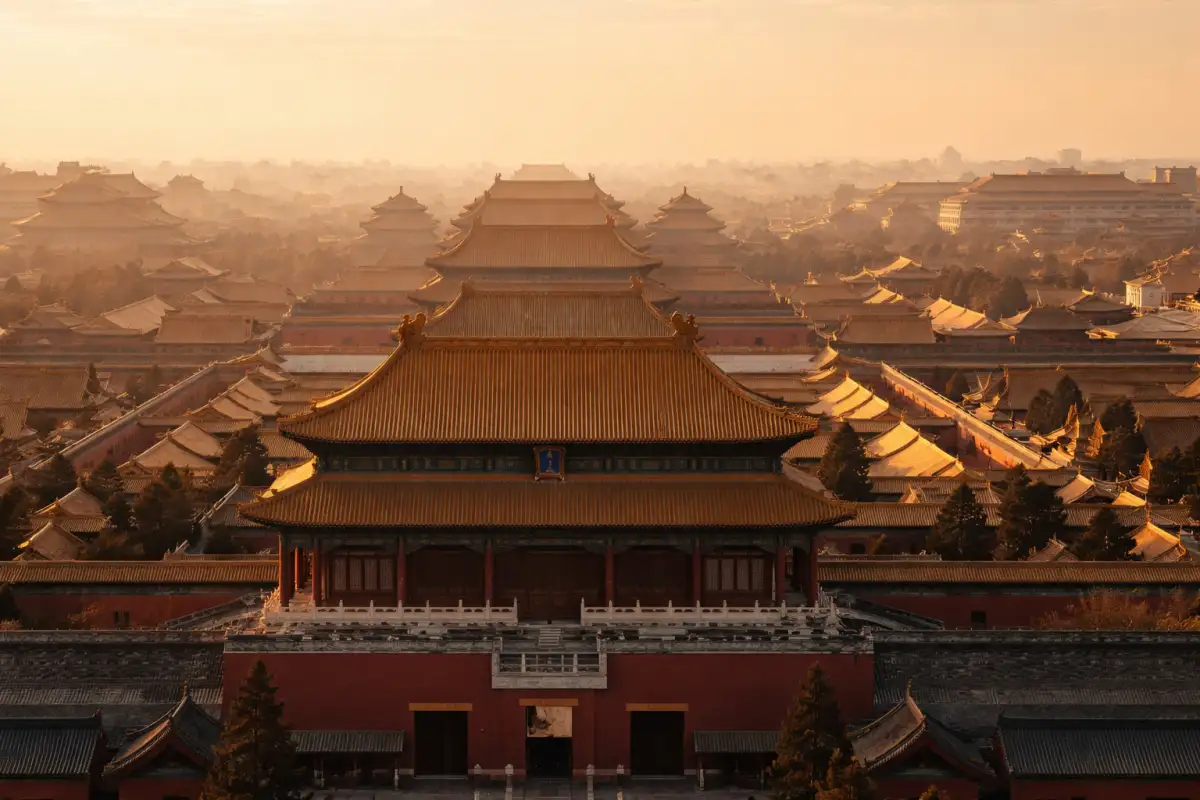
Most people rush through the Forbidden City (故宫, Gùgōng). They enter from the south, walk through the three great halls, take photos, and leave from the north. That takes about ninety minutes and you miss almost everything.
The Forbidden City is not one building. It is a city within a city — 72 hectares of palaces, gardens, courtyards, and corridors that housed 24 emperors across two dynasties. The main axis is grand and public, designed to overwhelm. But the real magic is in the side halls and the western and eastern wings, where the collections of ceramics, paintings, clocks, and jewellery are housed in smaller, quieter rooms.
Practical tips:
- Book tickets online in advance — walk-up tickets are not available. You need a passport number to book.
- Go early. Gates open at 8:30 and the first hour is the quietest.
- Budget at least three to four hours if you want to see more than the central axis.
- The Palace Museum closes on Mondays.
If you only visit one historical site in all of China, make it this one.
The Great Wall — skip Badaling
Every visitor to Beijing goes to the Great Wall. The question is which section. There are dozens of accessible points, and the experience varies enormously depending on where you go.
Badaling is the most famous and the most crowded. It has been fully restored, has cable cars, and on busy days feels more like a shopping mall than an ancient fortification. If you have a choice, skip it.
Mutianyu is the most practical alternative — about 90 minutes from central Beijing, well-restored but far less crowded. It has a cable car up and a toboggan ride down (genuinely fun). This is the section I’d recommend for most visitors.
Jinshanling and Simatai are wilder, less restored, and more rewarding if you want to hike. You will see crumbling watchtowers, overgrown steps, and long stretches where you are completely alone. This is the Wall as it actually is — not a monument, but a ruin slowly being reclaimed by the mountains.
No matter which section you choose, the experience is the same at its core: you stand on a stone ridge that runs across mountaintops for thousands of kilometres, built by hand over centuries, and you understand — physically, not just intellectually — what human determination looks like.
Hutongs — the old Beijing that is disappearing
Beijing’s hutongs (胡同) are narrow alleyways lined with traditional courtyard houses (四合院, sìhéyuàn). They are what Beijing was before the ring roads and the skyscrapers — a city of low grey walls, wooden doors, and shared courtyards where neighbours knew each other’s business.
Many hutongs have been demolished over the past three decades to make way for development. What remains is a mixture of the genuinely old, the carefully preserved, and the commercially renovated. Some hutong neighbourhoods, like Nanluoguxiang, are now fully tourist streets with bubble tea shops and souvenir stalls. Others, just a few streets away, are still residential — laundry hanging between trees, old men playing chess on stools, the smell of someone cooking dinner.
Walk through both kinds. The tourist hutongs show you what Beijing wants to preserve. The residential ones show you what it is actually like to live in a city that is constantly rebuilding itself.
The food — northern, hearty, unapologetic
Beijing food is northern Chinese food: wheat-based, heavier, less refined than Cantonese or Sichuan cuisine, and proud of it.
Peking duck (北京烤鸭) is the city’s most famous dish and it is worth the hype — but only at a proper restaurant. The duck is roasted until the skin is paper-thin and crackling, then carved tableside and served with thin pancakes, spring onion, cucumber, and sweet bean sauce. You wrap it yourself. The best-known restaurant is Quanjude (全聚德), founded in 1864, but locals often prefer Da Dong or Siji Minfu for a more modern take.
Beyond duck, try:
- Zhajiangmian (炸酱面) — thick wheat noodles with fermented soybean paste, minced pork, and julienned vegetables. Working-class Beijing in a bowl.
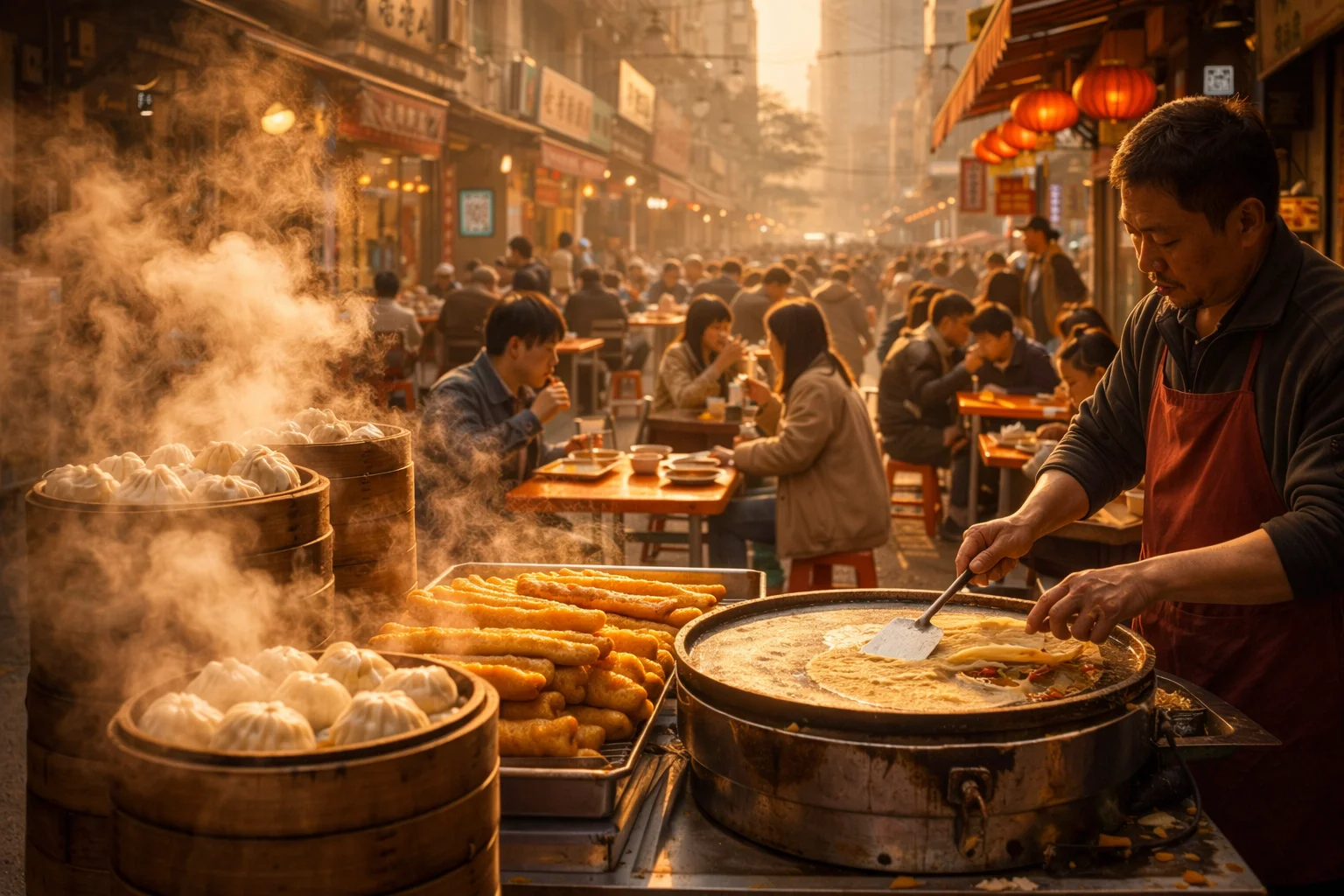
- Jianbing (煎饼) — the street breakfast crepe, made on a griddle with egg, crispy crackers, cilantro, and chili sauce. Best eaten at 7am from a cart.
- Lamb hotpot (涮羊肉) — Beijing-style hotpot is simpler than Sichuan hotpot: a copper pot of boiling water, paper-thin slices of lamb, and a sesame dipping sauce. The simplicity is the point.
- Douzhi (豆汁) — fermented mung bean juice. I’ll be honest: most non-Beijing Chinese people find it undrinkable. But it is authentically Beijing and you should at least try a sip.
Getting around
Beijing’s metro is vast — over 800 kilometres of track across 27 lines. It covers almost everywhere you’d want to go and costs 3–9 RMB per trip (roughly €0.40–1.20). Trains are frequent but can be extremely crowded during rush hours.
You will need Alipay or WeChat Pay to scan at the gates, or you can buy single-trip tickets from machines at each station.
Taxis and Didi are widely available. Traffic can be severe — a 15-kilometre taxi ride might take 20 minutes or 90 minutes depending on the time of day. Plan around this.
Cycling is excellent for shorter distances. Shared bikes are everywhere, and many main roads have dedicated bike lanes. Beijing is flat, which makes cycling easy.
The atmosphere — serious but alive
Beijing feels different from other Chinese cities. There is a seriousness to it — an awareness of being the capital, the place where decisions are made, where history happened and is still happening. People speak Mandarin with the Beijing accent (儿化音, érhuàyīn), adding a distinctive “r” sound to the end of words that sounds rough if you are used to southern Chinese speech.
The city is also surprisingly green. The old imperial parks — Beihai, the Summer Palace, the Temple of Heaven — are enormous and beautiful. On weekend mornings they fill with people practising tai chi, flying kites, singing opera, or simply walking. These parks are not tourist attractions to Beijing residents. They are daily life.
The air quality has improved dramatically in recent years, but Beijing still has hazy days, especially in winter. Check the forecast before packing.
A few days is enough — and not enough
I spent only a few days in Beijing, and I won’t pretend that makes me an expert. What I can tell you is this: even a short visit changes your understanding of China. Beijing is where the history, the politics, the ambition, and the contradictions of this country are most visible. It is not the most comfortable city, not the most charming, not the easiest to love. But it is the most important one to see.
If Chengdu is China’s stomach and its soul, Beijing is its memory. Every dynasty, every revolution, every reinvention of what “China” means has left its mark here — in the stones of the Forbidden City, in the width of the avenues, in the way people carry themselves with just a little more weight than anywhere else.
Go. Walk the Wall. Eat the duck. Sit in a hutong courtyard as the light fades. You will not understand all of it. Nobody does. But you will understand more than you did before.
If you are planning a trip, check whether you qualify for visa-free entry to China — it may be easier than you think. And for practical advice on what to prepare, read our first trip to China guide.