Chinese Characters Are Pictures: 10 象形字 That Prove It
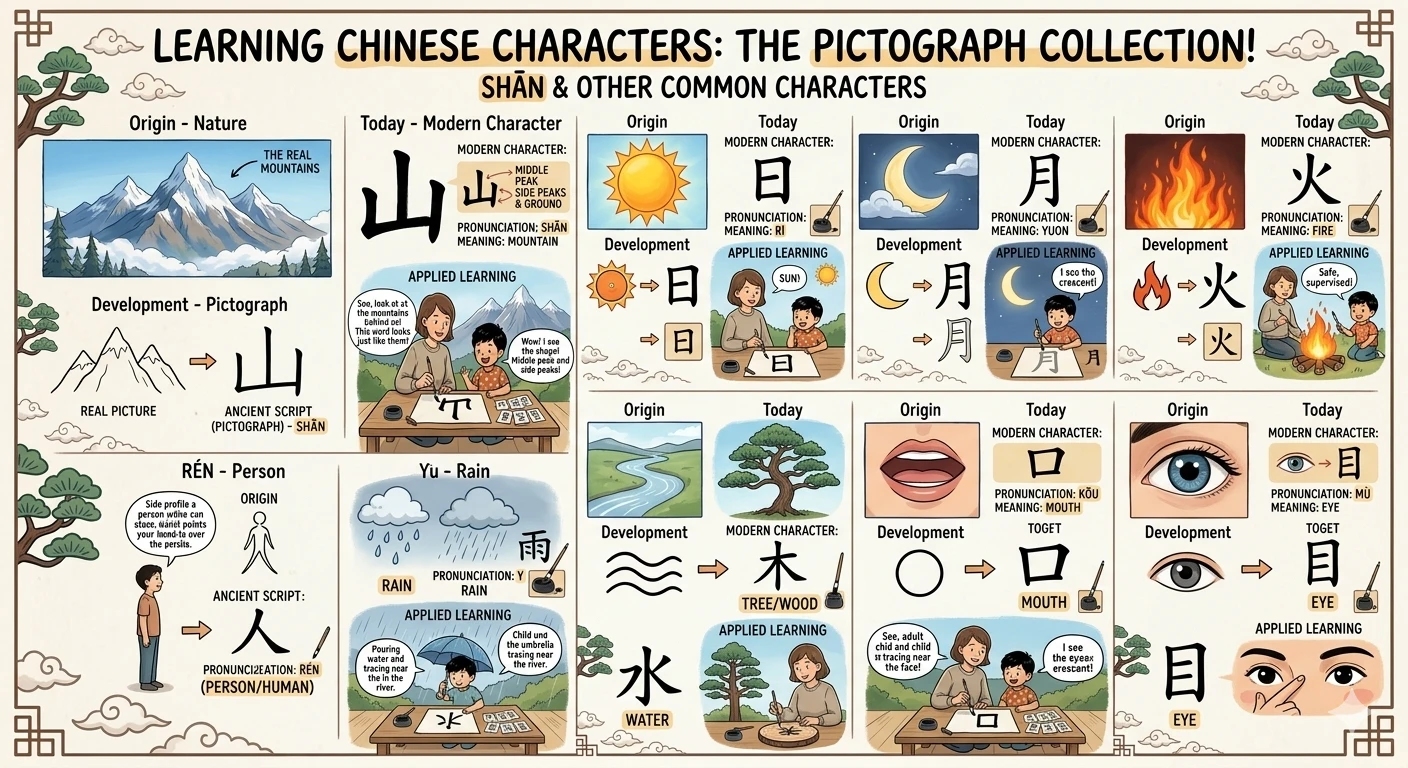
Chinese characters look impossibly complex — until you see where they came from. These ten pictographic characters (象形字) still look like what they mean, thousands of years later.
Most people look at Chinese characters and see an impossible wall of strokes. I get it. When you grow up writing with an alphabet, the idea of memorising thousands of unique symbols feels absurd. But here’s something most language courses don’t tell you early enough: many Chinese characters started as simple drawings. And some of them still look like what they mean.
These are called 象形字 (xiàngxíngzì) — pictographic characters. 象形 literally means “resembling form.” They’re the oldest layer of Chinese writing, dating back over 3,000 years to oracle bone inscriptions carved into turtle shells and animal bones during the Shang dynasty. While modern characters have been simplified and stylised over millennia, the visual logic is often still there if you know where to look.
Here are ten of the best examples. Once you see them, you can’t unsee them.
The natural world: 山, 水, 火
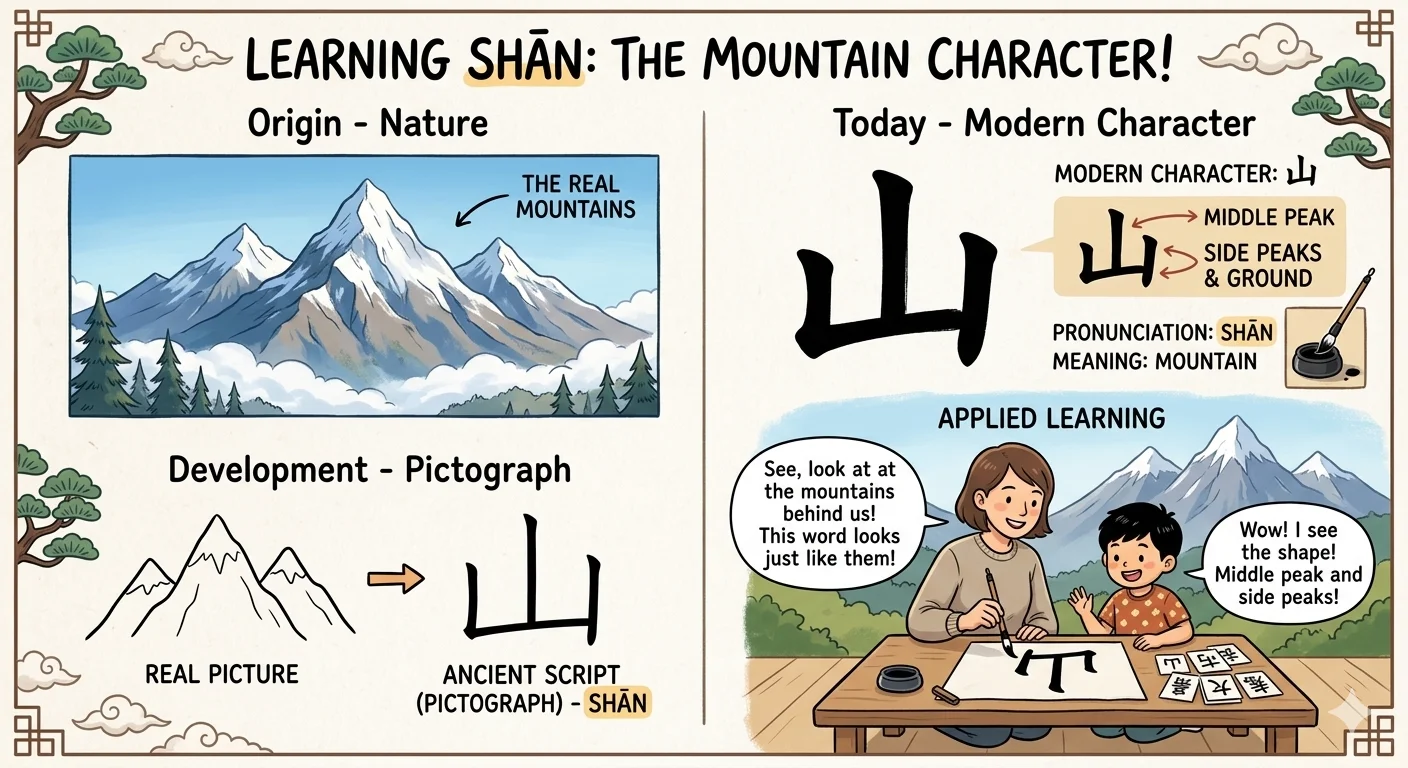
山 — shān — mountain
Look at it. Three peaks. The middle one taller. That’s a mountain. The ancient oracle bone version was even more obviously a drawing of mountain peaks, and the modern character hasn’t strayed far. This is usually the first character that makes people say, “Oh, I get it.”
You’ll see 山 everywhere in China — in city names (黄山 Huángshān, 泰山 Tàishān), in poetry, in everyday words like 山水 (shānshuǐ, literally “mountain-water,” meaning landscape or scenery).
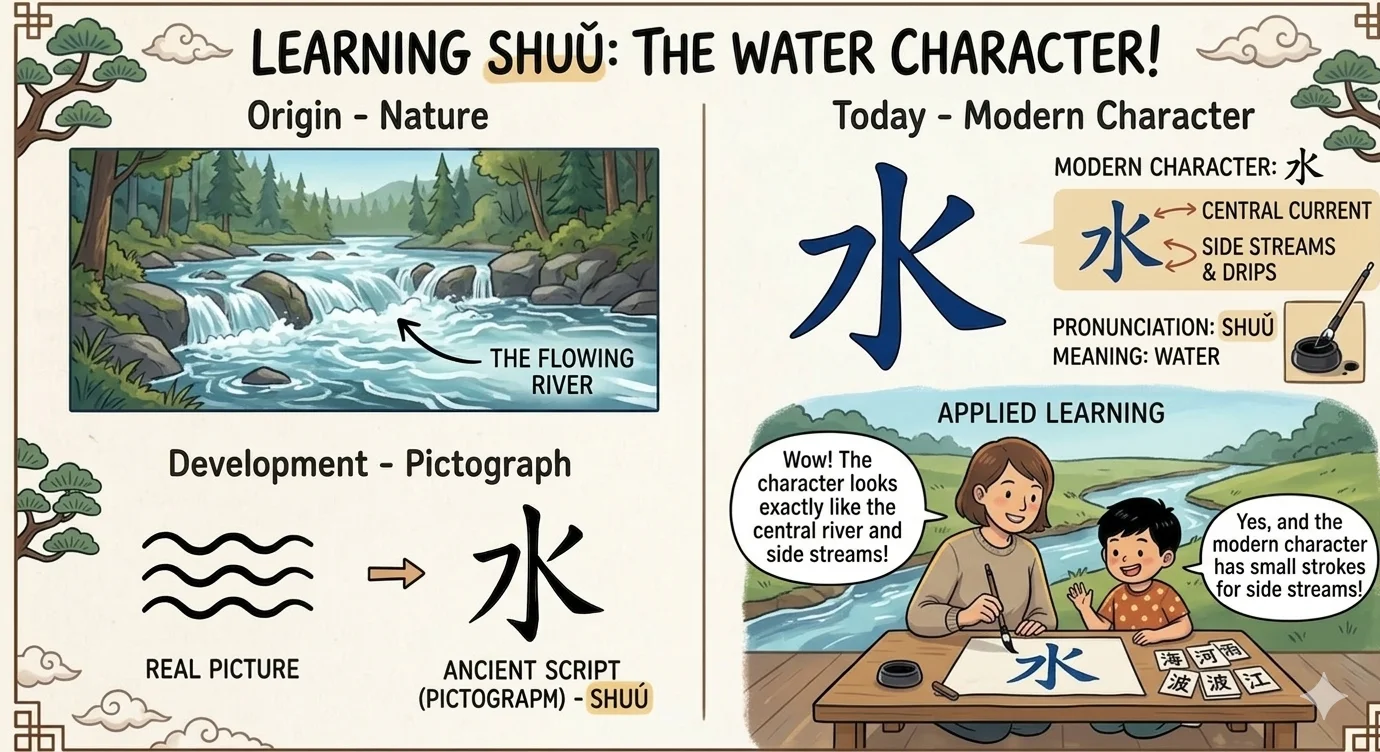
水 — shuǐ — water
The modern character is more abstract, but tilt your head and you can see it: a central stream with droplets or currents flowing on either side. The oracle bone version was unmistakably a drawing of flowing water — a wavy vertical line with splashes.
水 appears in countless compounds: 水果 (shuǐguǒ, fruit — literally “water-fruit”), 山水 (landscape), 水平 (shuǐpíng, level/standard — literally “water-flat,” because water always finds its level).
火 — huǒ — fire
Two flames rising from a base. The ancient version showed a bonfire even more clearly — a pile with flames leaping upward. The modern character keeps two upward strokes that still suggest flickering flames.
Fun compound: 火山 (huǒshān) means volcano — literally “fire-mountain.” Once you know 火 and 山, the word builds itself.

The sky above: 日, 月, 雨
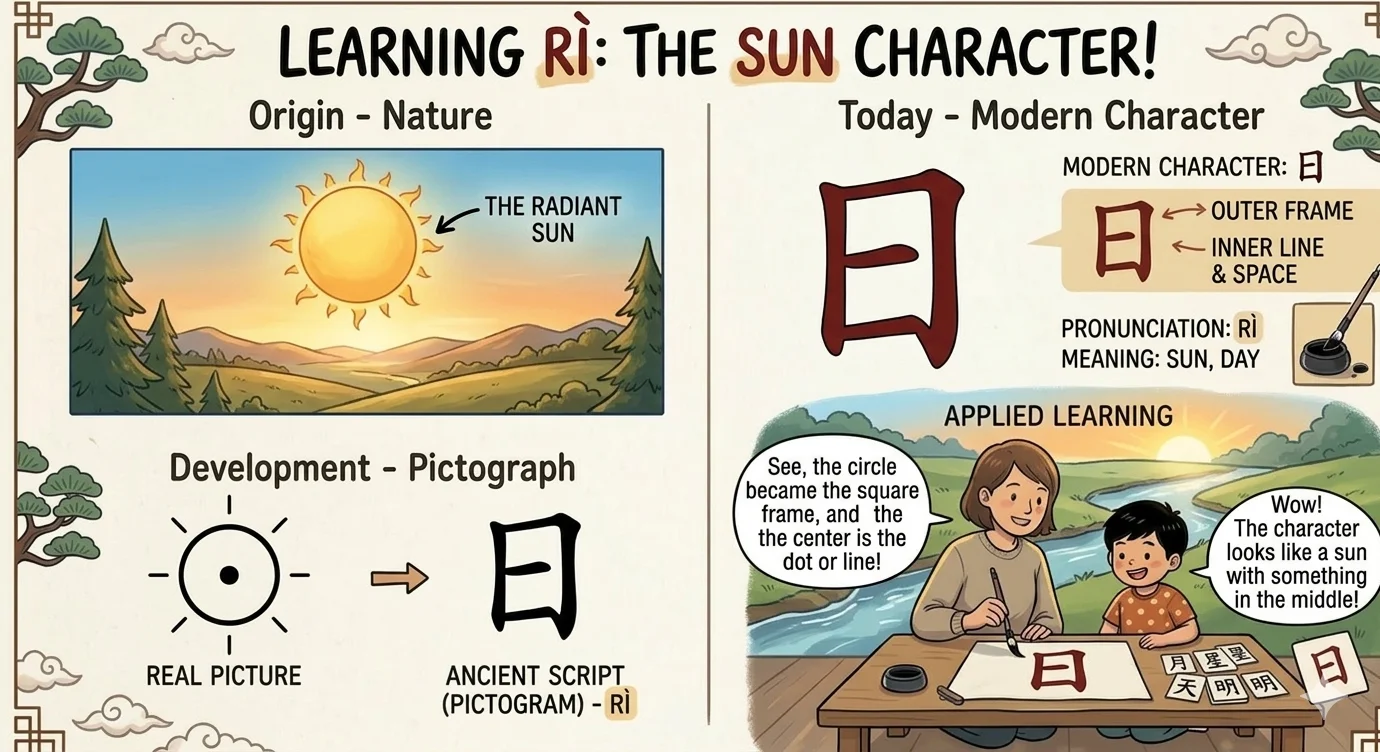
日 (rì) — sun / day
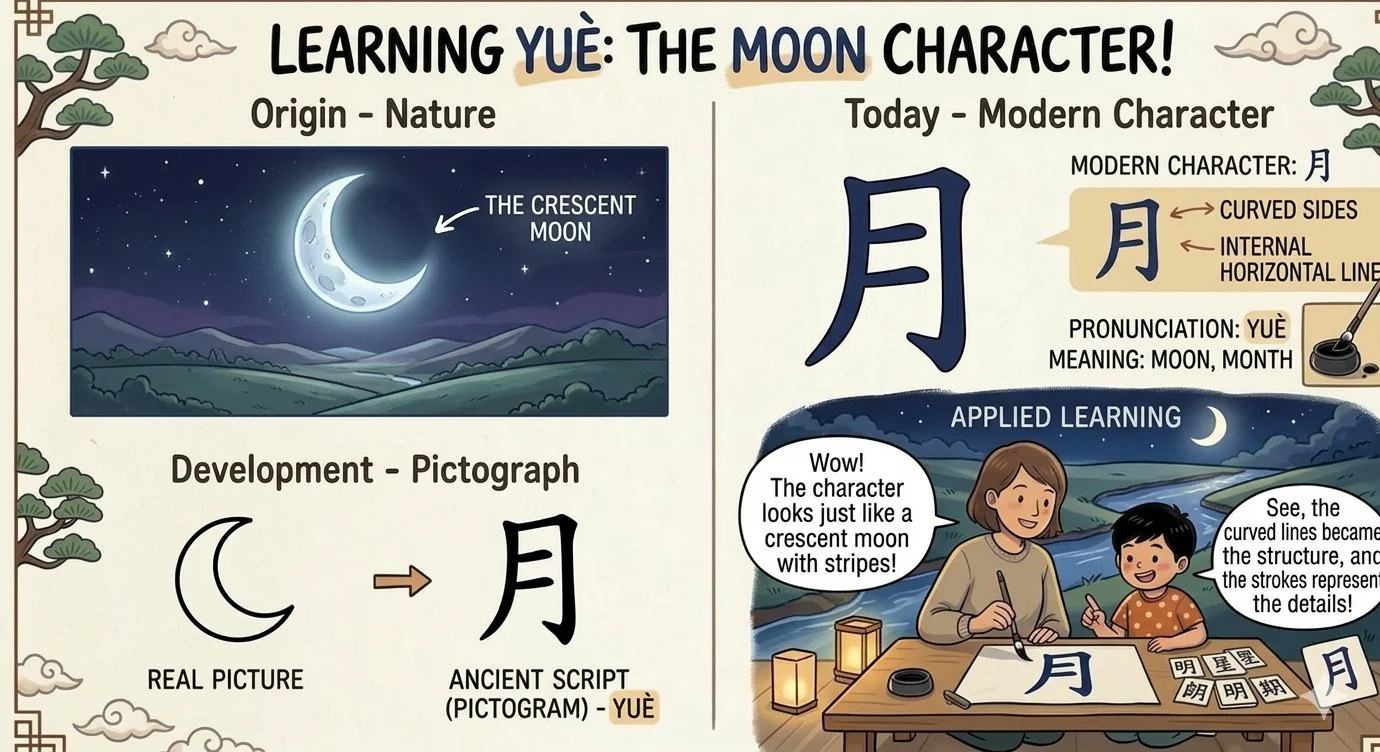
月 (yuè) — moon / month
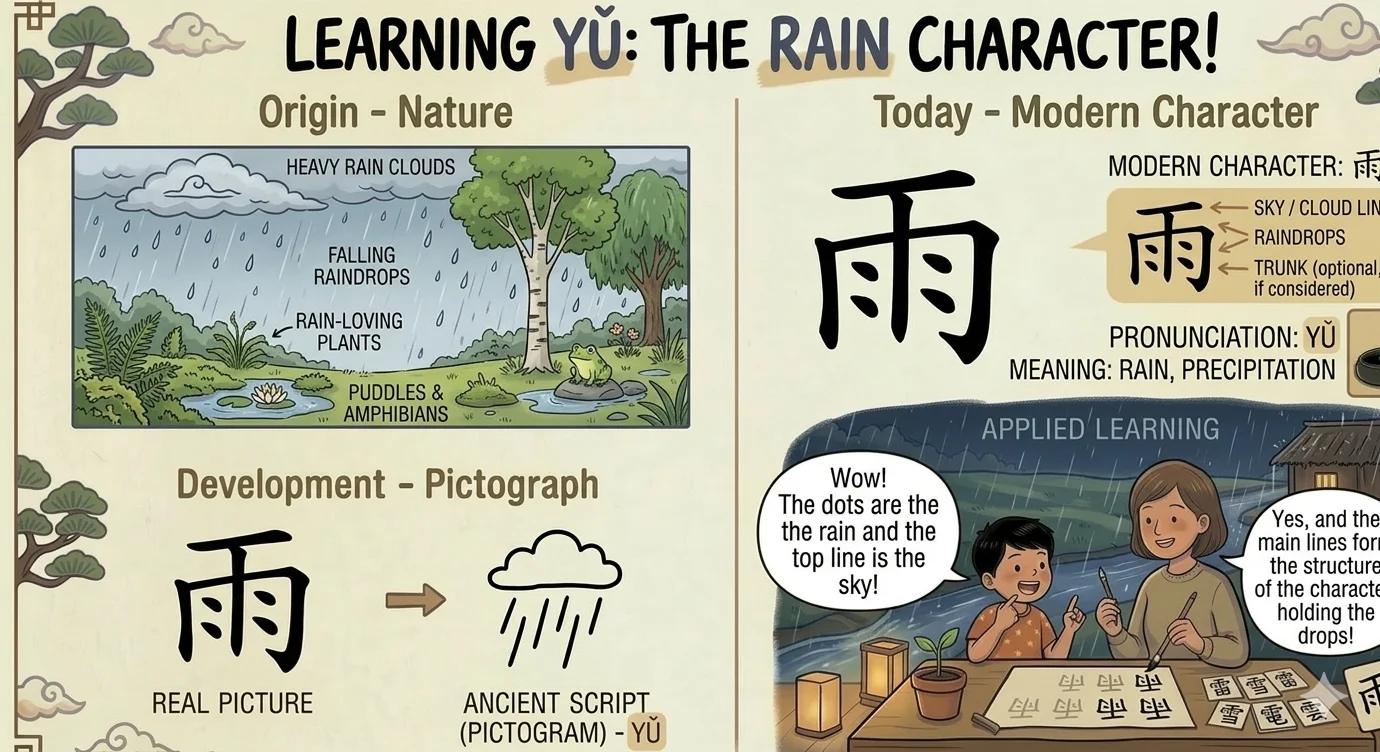
雨 (yǔ) — rain
日 — rì — sun
A rectangle with a line through the middle. It started as a circle with a dot in the centre — a drawing of the sun. Over time, the circle squared off (Chinese calligraphy prefers straight strokes), but the concept is identical.
日 means both “sun” and “day.” 日本 (Rìběn, Japan) literally means “origin of the sun” — the land where the sun rises, as seen from China.
月 — yuè — moon
A crescent shape. The ancient version was a clear crescent moon, and even the modern character retains that curved feeling. The two horizontal strokes inside represent the shadows on the moon’s surface.
月 also means “month” — because months in the traditional Chinese calendar follow lunar cycles. Monday to Sunday? 星期一 through 星期日. But “January” is simply 一月 (yīyuè, “month one”).
雨 — yǔ — rain
This one is beautiful. The top horizontal stroke is the sky. The line beneath it with a hook is a cloud. And the four dots? Raindrops falling. It’s a complete little scene in one character.
雨 shows up in weather words naturally: 雷 (léi, thunder) combines 雨 with 田 (field — the sound of thunder rolling across fields). 雪 (xuě, snow) puts 雨 on top of a character meaning “to sweep” — snow that sweeps down from the sky.
Living things: 木, 人
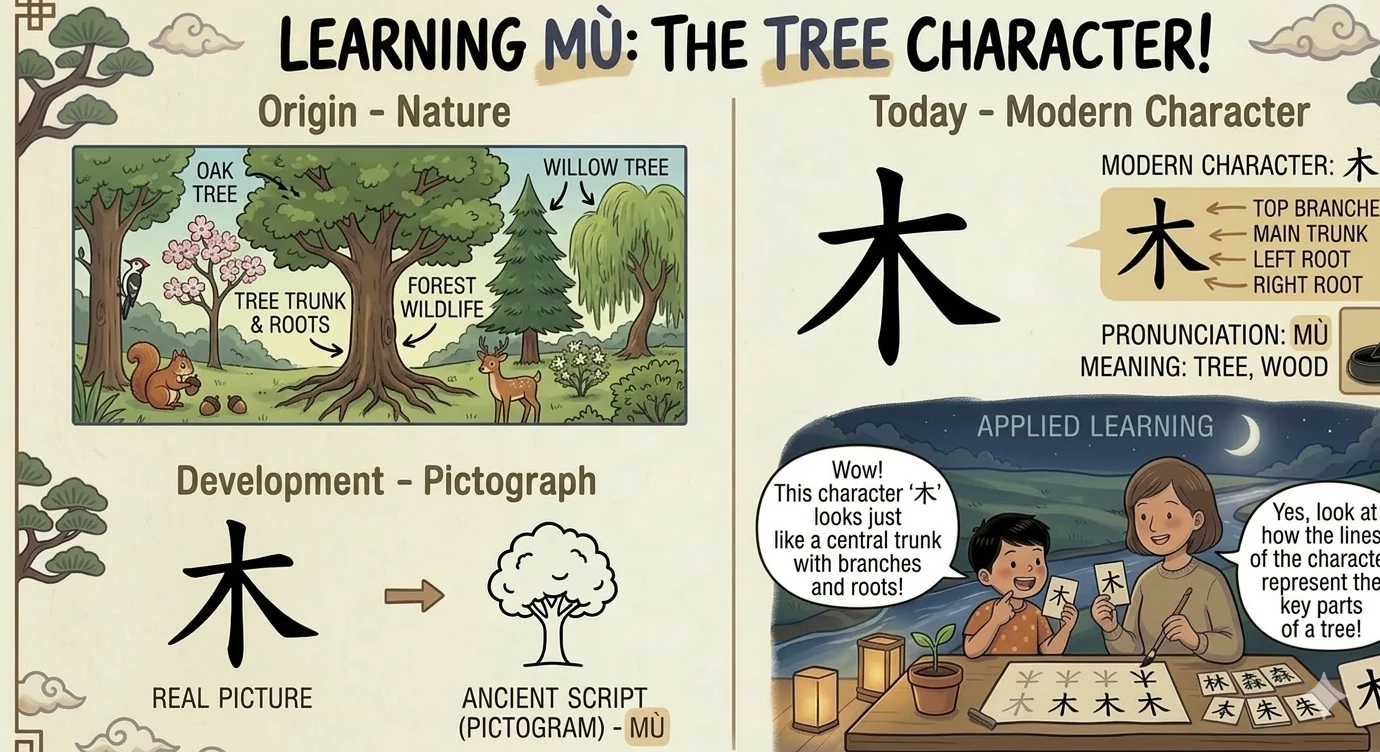
木 — mù — tree
A trunk with branches above and roots below. This is one of the most elegant pictographs. And it multiplies beautifully: stack two trees side by side and you get 林 (lín, forest/grove). Stack three and you get 森 (sēn, dense forest). The visual logic is perfect.
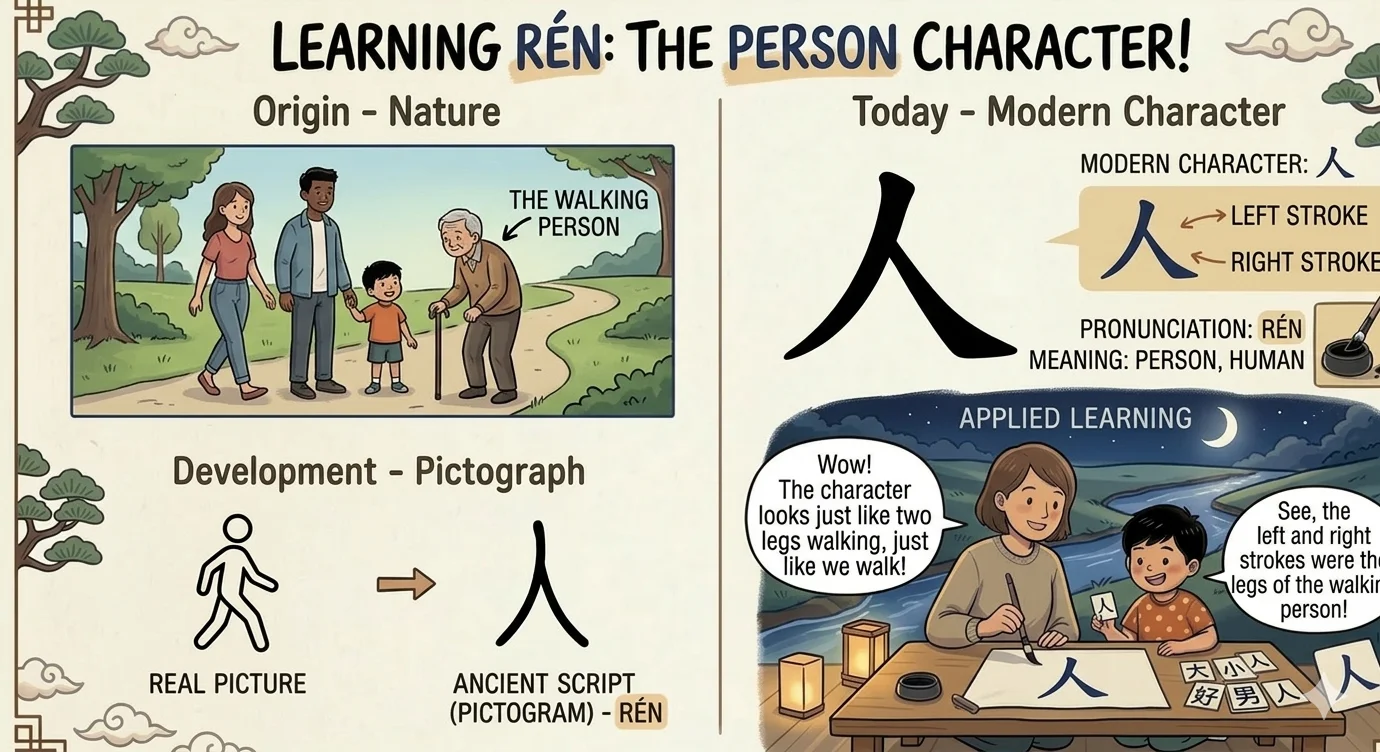
人 — rén — person
Two strokes: two legs walking. That’s it. A person in motion. The oracle bone version looked even more like a stick figure in profile. It’s the simplest and one of the most commonly used characters in the language.
Stack two people and you get 从 (cóng, to follow — one person following another). Stack three and you get 众 (zhòng, crowd/masses).
The human body: 口, 目
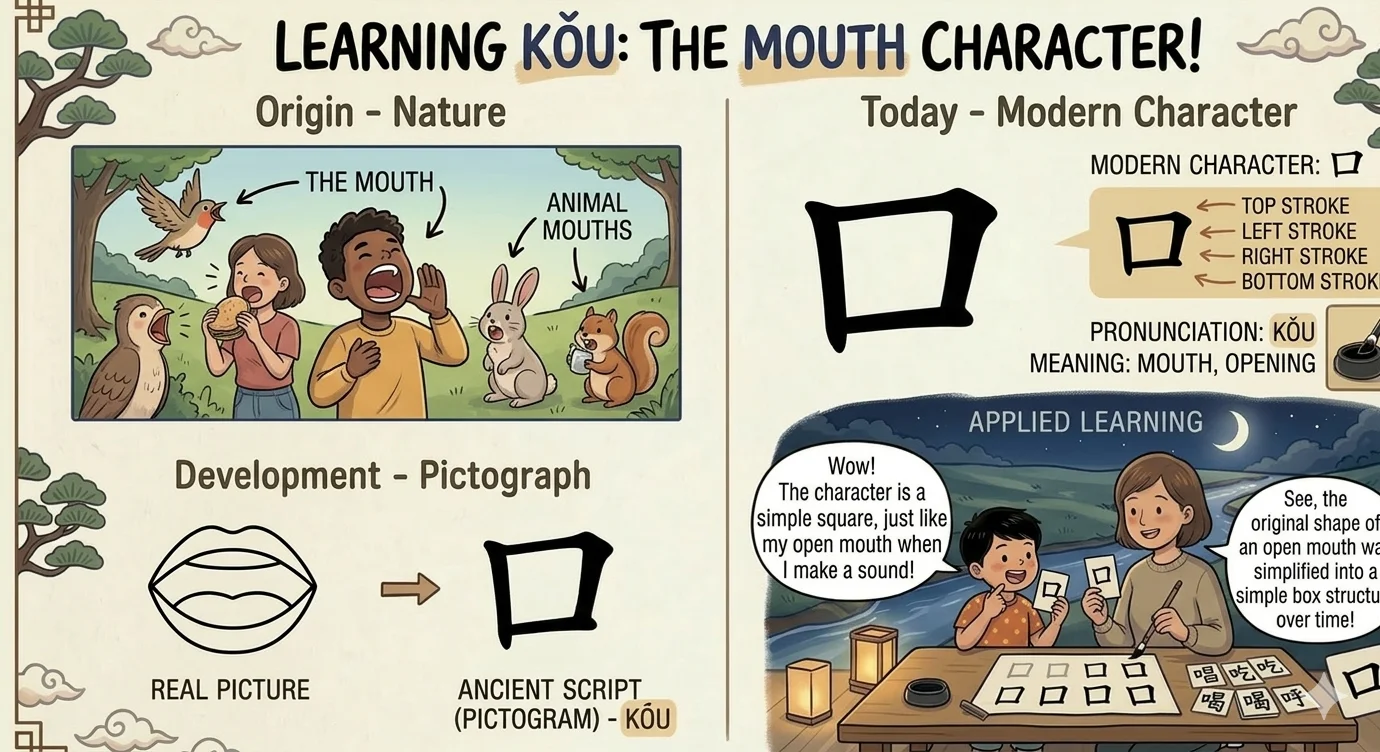
口 — kǒu — mouth
An open mouth. Just a square. The ancient version was a more rounded opening, but the meaning hasn’t changed in three thousand years. You’ll see 口 as a component inside hundreds of other characters — usually ones related to speaking, eating, or sounds.
目 — mù — eye
Turn it sideways and you’ll see an eye with a pupil. The oracle bone version was clearly an eye shape, drawn horizontally. The modern character rotated to vertical but kept the outline and the iris lines inside.
Don’t confuse it with 日 (sun) — 目 is taller and has one more horizontal stroke. An easy way to remember: the sun is square and compact, the eye is tall and narrow.

Why this matters for learning
Chinese has around 50,000 characters in total, but you only need about 2,500–3,000 to read a newspaper. And a huge number of those complex characters are built from simpler components — components like the pictographs above.
山, 水, 火, 日, 月, 木, 人, 口, 目, 雨 — these ten characters aren’t just vocabulary. They’re building blocks. Once you recognise them, you start seeing them inside more complex characters, and suddenly the writing system has a logic to it.
Not all Chinese characters are pictographic — most are actually phono-semantic compounds, combining a meaning component with a sound component. But pictographs are the foundation. They’re where it all started, and they’re the most intuitive way in.
If you’re a Nordic reader curious about Chinese, start here. Learn these ten. Draw them. See the pictures in them. It changes how the whole language looks.