What Does China Call Your Country? The Meaning Behind Nordic Names in Chinese
Finland means 'fragrant orchid.' Sweden means 'auspicious classic.' Here's what the Chinese names for every Nordic country literally mean — character by character.
When I moved to Finland, one of the first things my Finnish friends asked me was: “What do you call Finland in Chinese?” I said 芬兰 — Fēnlán. They nodded politely, assuming it was just a sound. Then I told them what the characters actually mean: “fragrant orchid.”
They looked at me like I was making it up.
I was not. In Chinese, every syllable is written as a character, and every character carries meaning. When foreign country names were translated into Chinese — mostly during the late Qing Dynasty and early Republic era — translators did not just match sounds. They chose characters carefully, picking ones with elegant or auspicious meanings where they could. The result is that many country names in Chinese are accidentally poetic.
The Nordic countries got some of the best ones.
How Chinese country names work
English uses an alphabet. If you hear “Finland,” you can write it down letter by letter without knowing what it means. Chinese does not work that way. There is no alphabet — only characters, each representing a syllable and a meaning.
So when Chinese translators needed to write “Finland” in Chinese, they had to pick characters that sounded roughly like “Fin-lan” while also looking respectable on paper. They could have chosen characters that mean “dustbin” and “lazy” — the sounds might have worked — but obviously they did not. They chose 芬 (fragrant) and 兰 (orchid).
This process is called 音译 (yīnyì) — phonetic translation. But because characters always carry meaning, even a phonetic translation tells a story. Some country names are purely phonetic, some are purely semantic (direct translations), and some land somewhere beautifully in between.
Here are the five Nordic countries, character by character.
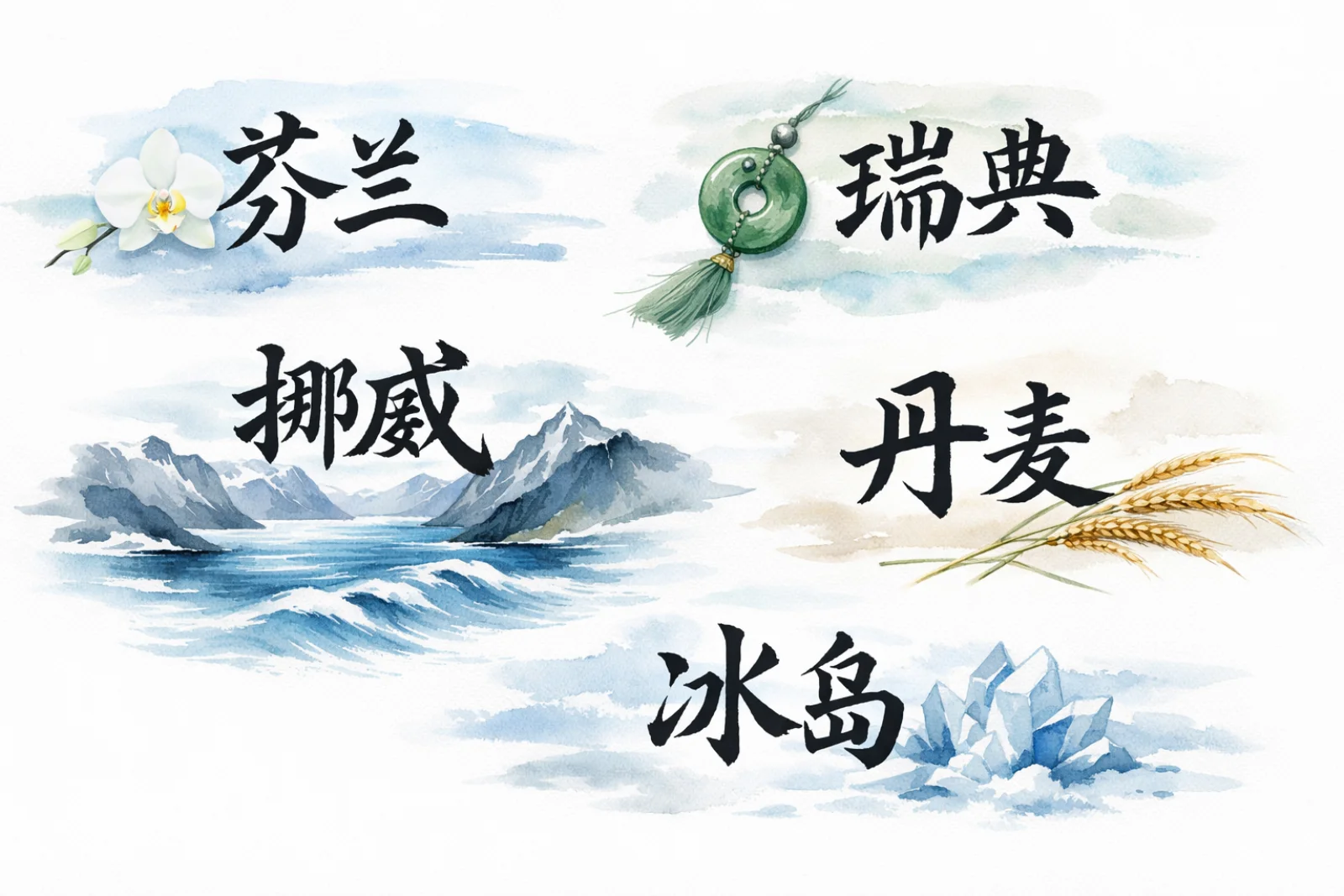
Finland — 芬兰 (Fēnlán)
Literal meaning: “Fragrant Orchid”
芬 (fēn) means fragrant, aromatic — the kind of clean, natural scent you associate with flowers and fresh grass. The character has the 艹 (grass) radical on top, anchoring it to the plant world.
兰 (lán) means orchid. In Chinese culture, the orchid is one of the “Four Gentlemen” (四君子) — orchid, plum blossom, bamboo, and chrysanthemum — four plants that represent noble character. The orchid specifically symbolises elegance, integrity, and quiet beauty.
Put them together and Finland becomes “fragrant orchid” — a name that evokes something clean, graceful, and naturally beautiful. For a country of forests, lakes, and fresh air, it is almost too perfect.
I have lived in Finland for years now, and I can tell you: the name fits. When Chinese people hear 芬兰, they unconsciously picture something pristine and serene — which is exactly what Finland is.
Sweden — 瑞典 (Ruìdiǎn)
Literal meaning: “Auspicious Classic”
瑞 (ruì) means auspicious, lucky, a sign of good fortune. It contains the 玉 (jade) radical on the left — and jade is the most revered stone in Chinese culture, associated with virtue, purity, and moral integrity. The character 瑞 is so positive that Chinese parents frequently use it in their children’s names.
典 (diǎn) means classic, canon, or ceremony — something authoritative and enduring. It appears in the word 经典 (jīngdiǎn, “classic”), 典礼 (diǎnlǐ, “ceremony”), and 字典 (zìdiǎn, “dictionary” — literally “character canon”).
Together, Sweden becomes “the auspicious classic” — something dignified, established, and blessed with good fortune. It is the most regal-sounding of all the Nordic names in Chinese. If country names were job titles, Sweden’s would be “Distinguished Elder.”
Norway — 挪威 (Nuówēi)
Literal meaning: “Shifting Power”
挪 (nuó) means to move, to shift, to rearrange. It contains the 扌(hand) radical on the left — the idea of using your hands to push something into a new position. On its own, it is a fairly neutral word.
威 (wēi) is where the weight lands. It means power, might, authority, dignity. It appears in 威严 (wēiyán, “majestic”), 威胁 (wēixié, “threat/force”), and 权威 (quánwēi, “authority”). This is a character that commands respect.
The combination 挪威 is primarily phonetic — it sounds like “Norway” — but the presence of 威 gives the name a strong, imposing feeling. Among the five Nordic countries, Norway’s Chinese name sounds the most commanding. Fjords and Vikings would approve.
Denmark — 丹麦 (Dānmài)
Literal meaning: “Cinnabar Wheat”
丹 (dān) means cinnabar — the deep red mineral pigment used in traditional Chinese medicine, Daoist alchemy, and classical painting. It is the colour of elixirs, transformation, and sincerity. The phrase 丹心 (dānxīn, “cinnabar heart”) means a loyal, devoted heart. 丹 is one of the oldest colour words in Chinese — warm, earthy, and loaded with cultural resonance.
麦 (mài) means wheat or grain. It is one of the most ancient agricultural characters, tied to the land, to harvest, to sustenance. The simplified character 麦 still carries the shape of a grain plant.
Together, Denmark becomes “cinnabar wheat” — red and golden, sincere and grounded. It is the most earthy of the Nordic names, with a warmth that the others do not quite have. Something about it feels like bread and firelight.
Iceland — 冰岛 (Bīngdǎo)
Literal meaning: “Ice Island”
冰 (bīng) means ice. The two strokes on the left (冫) are the ice radical — one of the most ancient radicals in Chinese, appearing in characters for cold (冷), frozen (冻), and winter (冬).
岛 (dǎo) means island. Look at the character closely: it has 山 (mountain) sitting on top of 鸟 (bird). Islands are mountains rising from the sea where birds gather. It is a small poem inside a single character.
Unlike the other four, Iceland’s Chinese name is not a phonetic approximation at all. It is a direct translation — what linguists call a calque. “Iceland” already means “ice land,” so Chinese simply translated the meaning: ice + island. It is the most honest name on this list. No poetry, no embellishment. Just: ice. Island. Done.
Bonus: the Nordics as a group
Chinese has two ways to refer to the Nordic region:
北欧 (Běi Ōu) — “Northern Europe.” 北 means north, 欧 is short for 欧洲 (Europe). This is what people actually say in daily conversation. Clean, geographic, efficient.
斯堪的纳维亚 (Sīkāndìnàwéiyà) — “Scandinavia.” This is a pure phonetic transliteration — seven characters long, unwieldy, and almost never used in casual speech. Chinese strongly prefers shorter names, so 北欧 wins every time.
Names are not accidents
These names were chosen by translators working decades or even centuries ago, often under pressure to standardise thousands of foreign terms into Chinese. They had to balance sound, meaning, and written form — all at once, in a language where every syllable is a picture.
The results are not random. They are small, deliberate acts of translation — and sometimes, almost by accident, they capture something true about the place. Finland really does feel like a fragrant orchid. Sweden really does carry itself like an auspicious classic. And Iceland really is an ice island.
Every time a Chinese person says 芬兰, they are — without knowing it — calling your country a fragrant orchid. That is not a bad name to have.
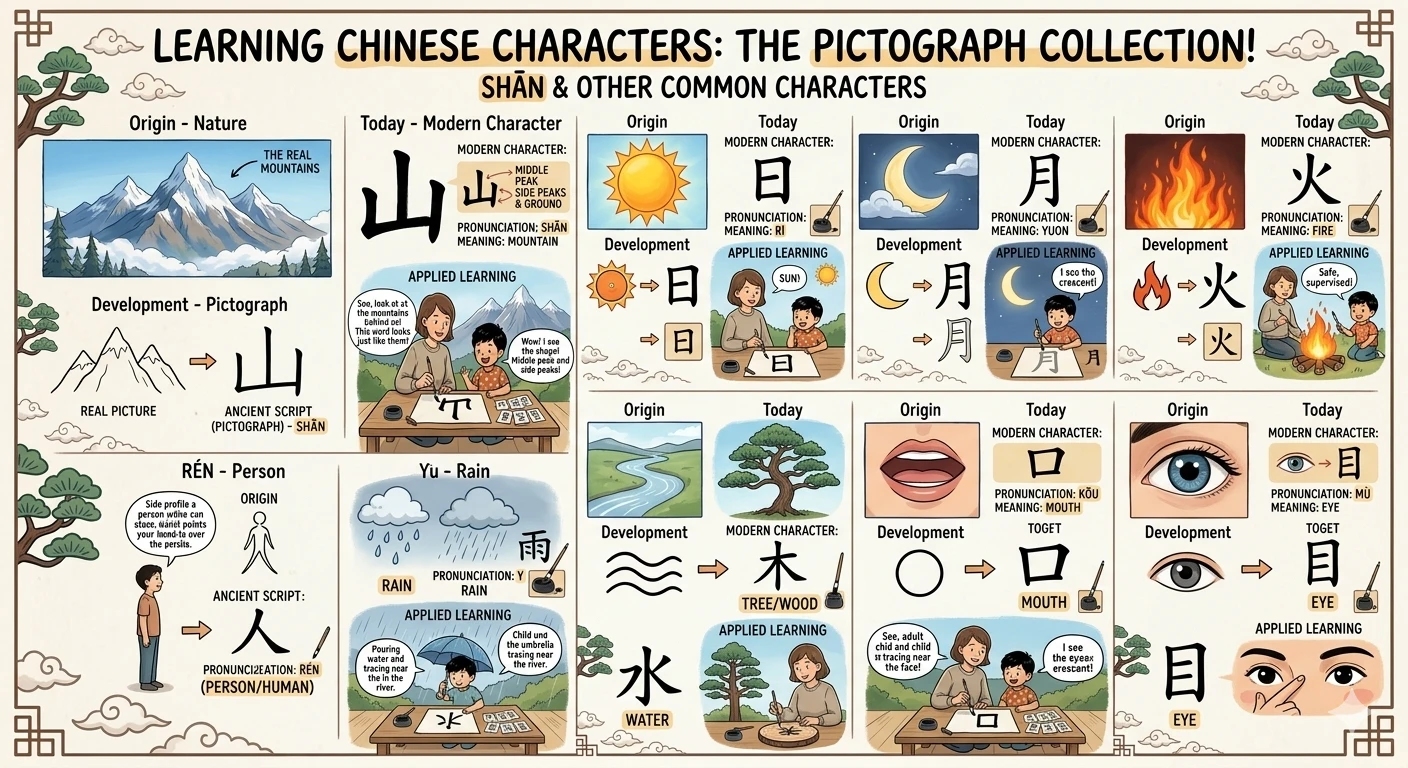
If you are curious about how Chinese characters work more broadly, start with 10 characters that are actually pictures. And if this article has made you curious about China, here is how easy it is to visit visa-free from Finland.