Shui Diao Ge Tou: The Moon Poem Every Chinese Person Knows by Heart
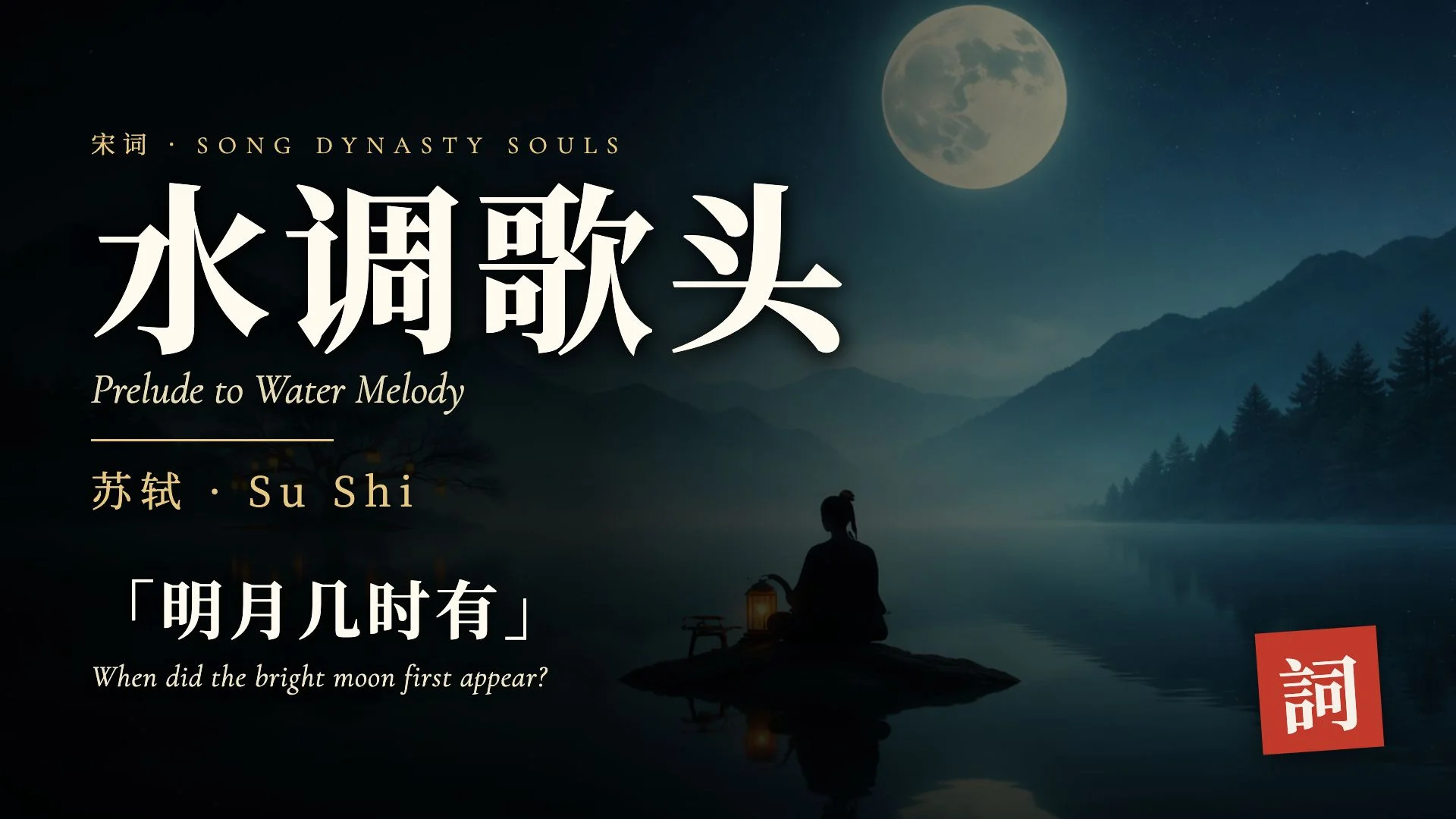
Su Shi wrote Shui Diao Ge Tou on a Mid-Autumn night in 1076, missing his brother. Nearly a thousand years later, it's still the first thing Chinese people think of when they look at the moon.
I was living in Finland for my second year when the Mid-Autumn Festival came around. I was alone in my apartment — my family was in China, my friends here did not know what the day meant, and I had no mooncakes. I looked out the window at the moon, which was absurdly full and bright over the birch trees, and the words came up from somewhere I did not know they had been stored:
明月几时有?把酒问青天。
When did the bright moon first appear? I raise my cup and ask the sky.
I had not recited those lines since middle school. But there they were, intact, waiting for exactly this kind of night. That is the power of Su Shi’s Shui Diao Ge Tou (水调歌头, Shuǐ Diào Gē Tóu) — “Prelude to Water Melody.” It does not just live in textbooks. It lives in the body, in the memory of anyone who grew up Chinese. And it activates at the precise moment you find yourself far from the people you love, looking at the same moon they are looking at.
The full poem
Listen — the complete poem, sung in Mandarin with English translation:
Original instrumental score — guqin, xiao flute, and pipa — composed for the philosophical mood of Su Shi's night under the Mid-Autumn moon.
Before I explain anything, here it is. Read it once, even if slowly.
The preface Su Shi wrote before the poem:
丙辰中秋,欢饮达旦,大醉,作此篇,兼怀子由。
Mid-Autumn of the year Bingchen. I drank happily through the night until dawn, got very drunk, and wrote this piece — also thinking of my brother Ziyou.
The poem itself:
明月几时有?把酒问青天。 不知天上宫阙,今夕是何年。 我欲乘风归去,又恐琼楼玉宇,高处不胜寒。 起舞弄清影,何似在人间。
转朱阁,低绮户,照无眠。 不应有恨,何事长向别时圆? 人有悲欢离合,月有阴晴圆缺,此事古难全。 但愿人长久,千里共婵娟。
And a translation, as faithful as I can make it without killing the music:
When did the bright moon first appear? I raise my cup and ask the blue sky. I do not know in the palaces of heaven what year it is tonight.
I want to ride the wind and return there, yet fear those jade towers and crystal halls — the heights are unbearably cold. I rise and dance with my own shadow. How could it be better than the world of men?
The moon turns past the vermilion pavilion, hangs low in the silken window, and shines on the sleepless. It should hold no grudge — so why is it always full when people are apart?
People know sorrow and joy, parting and reunion. The moon knows shade and shine, waxing and waning. Since ancient times, nothing has ever been perfect. Let us only hope that we both live long, and share this beautiful moon across a thousand miles.
A drunk poet missing his brother
The year was 1076, the eighth month of the lunar calendar — Mid-Autumn Festival. Su Shi (苏轼, Sū Shì), also known by his literary name Su Dongpo (苏东坡), was serving as a local official in Mizhou, a small city in what is now Shandong province. He was forty years old. He had not seen his younger brother Su Zhe (苏辙, Sū Zhé), courtesy name Ziyou, for seven years.
Seven years. Not because they had quarrelled, not because they had grown apart, but because the Song Dynasty bureaucracy had posted them to different ends of the empire. Su Shi was in Mizhou. Su Zhe was in Jinan, roughly 300 kilometres away — which, in the eleventh century, might as well have been on the moon.
They wrote to each other constantly. Su Shi’s letters to his brother are some of the most touching documents in Chinese literary history. But letters are not the same as sitting across a table from someone, sharing food, arguing about poetry. Su Shi knew this. The ache of it runs through everything he wrote during these years.
On this particular night, he drank. He drank heavily, by his own admission — dà zuì, “very drunk.” And at some point between the wine and the moonlight, the poem came out.
It is not a careful, sober composition. It is a man looking at the moon and having an argument with the universe about why beautiful things and painful things always seem to arrive together.
Who was Su Shi?
If you know only one Chinese poet, it is probably Li Bai or Du Fu — the two great Tang Dynasty poets. But if you asked most Chinese people which poet they feel closest to, the answer would often be Su Shi.
He was born in 1037 in Meishan, Sichuan province. He passed the imperial examination at twenty-one with such brilliance that the chief examiner, Ouyang Xiu (欧阳修), one of the greatest literary figures of the age, reportedly said: “I should step aside and let this young man take the lead.” Whether the quote is exactly true hardly matters — the point is that Su Shi arrived in Chinese letters like a force of nature and never let up.
He was a poet, a prose essayist, a calligrapher, a painter, a statesman, a philosopher, an engineer, a gourmand. He invented — or at least perfected and gave his name to — Dongpo pork (东坡肉), a slow-braised pork belly dish still served in restaurants across China today. He designed water systems. He wrote about tea with real knowledge. He was funny, generous, stubborn, and spectacularly bad at court politics.
That last quality cost him. Su Shi spent much of his career being exiled to increasingly remote postings — Huangzhou, Huizhou, finally Hainan Island, which in the eleventh century was considered barely civilised. Each time, he picked himself up, made friends with the locals, wrote extraordinary poetry, cooked good food, and found ways to be useful. He built a hospital in Hangzhou during a plague. He improved the West Lake with a causeway that still bears his name — the Su Causeway (苏堤), where people walk and take photos to this day.
He was, in other words, the kind of person who refuses to be diminished by circumstances. And this quality — this resilience dressed in warmth and humour — is what makes Shui Diao Ge Tou the poem it is.
What makes this poem work
The genius of the poem is in its structure of argument. Su Shi is not just expressing sadness. He is thinking his way through it, in real time, while drunk.
The first stanza is escapist fantasy. He looks at the moon and wants to leave the human world entirely. Fly up on the wind, join the celestial palaces. This is a classic Daoist impulse — the desire to transcend, to become immortal, to shed the weight of human attachment. For a moment, he is genuinely tempted.
But then he catches himself: 高处不胜寒 — “the heights are unbearably cold.” The heavenly realm might be pure and beautiful, but it would also be lonely and frozen. He would be free of suffering, but also free of everything that makes life worth living. So he dances with his shadow — a gesture that is both playful and melancholy, a man keeping himself company — and decides that the human world, messy and imperfect as it is, is where he belongs.
何似在人间。 How could it be better than the world of men?
That single line is the turn. It is Su Shi choosing the earth over heaven, the real over the ideal, the flawed present over the perfect nowhere.
The second stanza brings him back to his specific pain. The moon moves across the sky, passes his window, shines on him as he lies awake. And now he confronts the moon directly — not with wonder but with a kind of tender accusation. Why are you always fullest when people are separated? What kind of cosmic design is that?
He could stop there, in bitterness. But he does not. Instead he reaches for what might be the most mature thought in all of Chinese poetry:
人有悲欢离合,月有阴晴圆缺,此事古难全。
People have sorrow and joy, parting and reunion. The moon has shadow and light, waxing and waning. Since ancient times, nothing has ever been whole.
This is not resignation. It is recognition. Imperfection is built into the structure of reality itself. The moon cannot always be full. People cannot always be together. And instead of raging against this or retreating into fantasy, Su Shi accepts it — and then goes further:
但愿人长久,千里共婵娟。
Let us only hope that we both live long, and share this beautiful moon across a thousand miles.
That final couplet is why the poem has lasted nearly a thousand years. It does not promise reunion. It does not deny pain. It says: we cannot be together tonight, but we are both alive, and we are both looking at the same moon. That is enough. That has to be enough.
What is Song ci?
A quick note on the form, because it matters.
Shui Diao Ge Tou is not a shi (诗), the regular-verse poetry form most people associate with Chinese poetry. It is a ci (词, cí) — a lyric form that originated as words written to pre-existing melodies. The name Shui Diao Ge Tou — “Prelude to Water Melody” — is not Su Shi’s title. It is the name of the tune pattern (cipai, 词牌) he used.
Song Dynasty ci (宋词, Sòng cí) is one of the great literary achievements of Chinese civilisation. If Tang poetry is formal, balanced, and architecturally precise — think of it as classical columns and clean lines — then Song ci is more fluid, more emotional, more personal. The form allowed for irregular line lengths, which gave poets room to breathe, to shift rhythm, to follow the shape of a thought rather than the grid of a structure.
The cipai dictated the number of lines, the number of characters per line, and the tonal pattern — but within those constraints, the poet was free. It is a bit like writing lyrics to a jazz standard: the chord changes are fixed, but what you do with the melody is yours.
There are over 800 cipai in the Song tradition. Some became far more famous than others — Shui Diao Ge Tou is one of the most recognisable, partly because of Su Shi’s poem, partly because the pattern itself allows for a satisfying emotional arc: expansive opening, compressed middle, transcendent close.
The original melodies are mostly lost. We read Song ci as poetry now, not as songs. But the musical DNA is still there in the rhythm of the lines — the way they push forward and pull back, rise and fall. If you read the Chinese aloud, even without understanding every word, you can hear the song underneath.
The Mid-Autumn connection
In China, the Mid-Autumn Festival (中秋节, Zhōngqiū Jié) falls on the fifteenth day of the eighth lunar month — always a full moon. It is a family holiday, a reunion holiday. You eat mooncakes, you look at the moon, you are supposed to be together with the people who matter most.
Su Shi’s poem has become so completely fused with this festival that the two are almost inseparable. If you turn on Chinese television on Mid-Autumn night, you will hear this poem recited, sung, referenced, and quoted in every possible way. Pop songs sample its final couplet. Mooncake gift boxes print its lines on the packaging. Children perform it in school assemblies. It is the default text message Chinese people send each other on Mid-Autumn evening — 但愿人长久,千里共婵娟 — wishing health and shared moonlight across the distance.
What makes this bond so strong is that the poem captures exactly the emotion the festival is designed to hold: the bittersweet knowledge that the people you love are not always within reach. China is a vast country, and Chinese history is a history of separation — families split by war, by work, by bureaucratic assignment, by emigration. The Mid-Autumn Festival acknowledges this. The mooncake is round because roundness symbolises wholeness, reunion. But the festival exists precisely because reunion is not guaranteed.
Su Shi’s poem says out loud what the festival implies quietly. We are apart. We wish we were not. The moon is beautiful tonight. I hope you are seeing it too.
For someone living abroad — and there are tens of millions of Chinese people living outside China now — this poem hits with a particular weight. The moon really is the same moon. You really are looking at it from opposite sides of the planet. And the wish is the same one Su Shi made in 1076: let us live long enough to keep sharing it.
Why I keep coming back to it
I want to be honest about something. When I first learned this poem in school, I did not feel much about it. I was twelve or thirteen, required to memorise it for a test, and I did what every Chinese student does: I crammed the characters, recited it correctly, got my marks, and moved on. The words went into memory but not into understanding.
It was only after I moved to Finland that the poem found me again.
Living far from family changes your relationship with Chinese poetry. Lines that felt like textbook exercises suddenly become personal. 何事长向别时圆? — Why is the moon fullest when people are apart? That is not a rhetorical question anymore when your parents are 7,000 kilometres away and the autumn moon is hanging enormous over a Finnish lake.
The thing about Su Shi is that he was not writing from a position of serenity. He was drunk and lonely and missing his brother. The wisdom at the end of the poem — the acceptance, the hope — is hard-won. It comes after the fantasy of escape, after the accusation against the moon, after the honest admission that nothing in life is ever complete. He earns the final couplet by going through the pain first, not around it.
That is why the poem lasts. It does not offer easy comfort. It offers the only comfort that actually works: the acknowledgement that imperfection is universal, and that love persists across distance if both people are willing to look up.
Su Shi’s other lives
One of the things that makes Su Shi feel so alive, even a thousand years later, is that he was not just a poet. He was a person — messy, curious, appetite-driven, incapable of keeping his opinions to himself.
His food writing alone would make him famous. Dongpo pork (东坡肉) — pork belly braised slowly in soy sauce, wine, and sugar until it collapses into tenderness — originated during his exile in Huangzhou. The story goes that pork was cheap there because the wealthy preferred lamb and the poor did not know how to cook pork well. Su Shi figured it out and wrote a short, cheerful essay about the technique. The dish became a Hangzhou classic and is still on menus all over China. If you have eaten braised pork belly in a Chinese restaurant, you have tasted something Su Shi helped invent.
He also wrote about tea with real expertise, debated philosophy with Buddhist monks, designed public works projects, and once got arrested because a political rival decided his poems contained veiled criticisms of government policy — which, to be fair, they probably did. The case, known as the “Crow Terrace Poetry Trial” (乌台诗案, Wūtái Shī’àn), nearly got him executed. He was saved by intervention from allies and the retired empress dowager, then exiled to Huangzhou — where, instead of being destroyed by the experience, he wrote some of the best poetry and prose of his life.
This pattern repeated throughout his career. Exile, creative explosion, recall, political trouble, exile again. He was pushed further and further from the centre — Huangzhou, Huizhou, Danzhou on Hainan Island. And at each stop, he adapted. He made wine from local fruit. He befriended farmers. He built things. He wrote. He cooked.
He died in 1101, at sixty-five, on his way back from his final exile. He was being recalled to the capital — too late, as it turned out. But even at the end, his letters were warm and funny and full of observations about the food along the road.
Reading the poem aloud
If you want to experience Shui Diao Ge Tou properly, try reading it aloud in Chinese — or listen to someone who can. The sounds matter. Classical Chinese poetry is built on tonal patterns, and while modern Mandarin has simplified the tonal system from what it was in Song Dynasty Chinese, you can still feel the rise and fall.
The opening — Míng yuè jǐ shí yǒu? Bǎ jiǔ wèn qīng tiān — has a questioning rhythm, an upward lilt. The words are simple: bright, moon, when, have, hold, wine, ask, blue, sky. Eight-year-olds can understand every character. But the image is vast.
The closing — Dàn yuàn rén cháng jiǔ, qiān lǐ gòng chán juān — rolls like a benediction. The sounds are round and open. Cháng jiǔ (long enduring) and chán juān (beautiful, used here for the moon) are soft, warm words. They feel like an embrace.
This is something you lose in translation, inevitably. English can carry the meaning but not the music. The poem in Chinese has a physical effect — a vibration in the chest, a slowing of breath — that no translation can fully reproduce. If you have a Chinese friend or colleague, ask them to recite it for you. Watch what happens to their face when they reach the last two lines.
What the poem means now
Nearly a thousand years after Su Shi wrote it on a drunken Mid-Autumn night in Mizhou, Shui Diao Ge Tou is still doing what it did then: holding space for the people who are far from the people they love.
It appears in pop songs — the most famous being Faye Wong’s (王菲) 1995 rendition, “但愿人长久,” which set the poem to a modern melody and became one of the most beloved Mandarin songs of the twentieth century. It appears in films, in television dramas, in graduation ceremonies. It appears, every single year, in the text messages sent between Chinese families on Mid-Autumn night.
The reason it endures is not because it is beautiful — though it is. It is because it is true. The observation at its heart — that nothing is ever fully complete, and that the best we can do is hope for long life and shared beauty across distance — is as accurate now as it was in 1076. More accurate, perhaps, in a world where Chinese families are scattered across continents and the distance that separated Su Shi from his brother is now the distance between Shanghai and Helsinki.
But the moon is still the same moon. And the wish is still the same wish.
但愿人长久,千里共婵娟。
Let us live long. Let us share this moon.
If this poem made you curious about Chinese music and philosophy, read about Xiao Yao You — a guqin piece built on Zhuangzi’s vision of freedom. And if the Mid-Autumn Festival has you thinking about Chinese food traditions, here is what you should know about tea culture.