The Butterfly Lovers: How Two Students Wrote China's Most Beautiful Concerto
The Butterfly Lovers violin concerto blends a thousand-year-old love story with Western orchestral form. Here's the story behind the music — and why it still moves people to tears.
I was sitting at the side of the rink, watching my daughter practise her figure skating, when a young girl glided to the centre of the ice. The music started — and within three notes I knew exactly what it was: the Butterfly Lovers violin concerto (梁祝小提琴协奏曲, Liáng Zhù xiǎotíqín xiézòuqǔ). The melody rose through the cold air of a Finnish ice rink, and the girl began to move with it — arms tracing the shape of something ancient and enormous.
I had heard this piece hundreds of times growing up in China. At school concerts, on television, at weddings. But hearing it here, thousands of kilometres from where it was written, while a young skater translated it into movement on ice — that was something new. I sat there, genuinely moved, and realised that most people in Finland have probably never heard this piece by name. But almost everyone who hears it remembers it.
This is the story behind it.
Listen — excerpt:
Listen to the full concerto on Audio.com →
The legend of Liang Shanbo and Zhu Yingtai
The music is based on one of China’s oldest and most famous love stories — often called “China’s Romeo and Juliet,” though it is older by at least a thousand years.
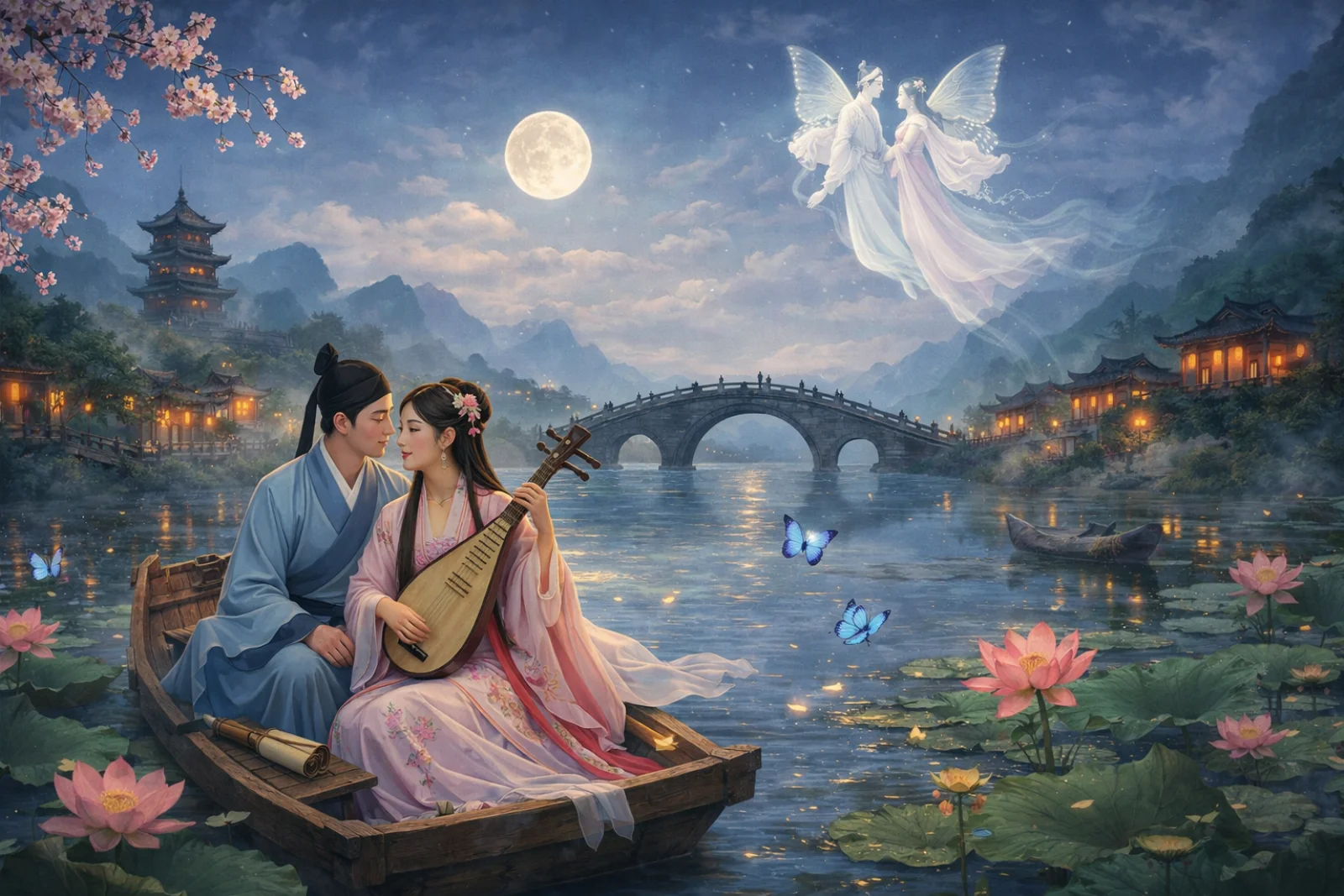
In the Eastern Jin Dynasty, around the fourth century AD, a young woman named Zhu Yingtai (祝英台) disguised herself as a man in order to attend school — something forbidden to women at the time. There she met Liang Shanbo (梁山伯), and the two became inseparable. They studied together for three years. Liang Shanbo never realised his closest friend was a woman.
When Zhu Yingtai was called home, she hinted at the truth, but Liang Shanbo did not understand. By the time he finally learned she was a woman and rushed to find her, it was too late — her family had promised her to a wealthy man named Ma Wencai.
Liang Shanbo fell ill from grief and died. On the day of Zhu Yingtai’s wedding procession, she stopped at his grave and wept. The earth split open. She threw herself in. And from the grave, two butterflies rose — flying together, never apart again.
It is not just a love story. It is a story about the cost of rigid social rules, the courage of a woman who refused to accept her circumstances, and the idea that some bonds outlast even death. Every Chinese person knows this tale. It is part of the cultural furniture.
How two students created the concerto
In 1959, two students at the Shanghai Conservatory of Music were given an assignment: write a piece that fused Chinese musical traditions with Western orchestral form. They were He Zhanhao (何占昊) and Chen Gang (陈钢) — both in their twenties, neither yet established as a composer.
China was ten years old as a modern nation. There was a hunger for art that felt both Chinese and contemporary, something that could stand alongside Tchaikovsky and Dvořák without abandoning its own roots.
He Zhanhao grew up listening to Yue opera (越剧), a lyrical form of Chinese opera from Zhejiang province — the same region where the Butterfly Lovers legend originated. He understood how the story sounded in the Chinese tradition: the sliding notes, the emotional bends, the way the voice could carry sorrow and joy simultaneously.
Chen Gang brought formal training in Western composition — sonata form, orchestration, harmonic structure.
Together, they built something remarkable. The violin takes the role of the storyteller, essentially singing in the style of a Yue opera vocalist — bending notes, sliding between pitches, imitating the human voice. The orchestra provides the Western framework: a concerto in three sections that map directly to the story’s three acts. Love. Separation. Transformation.
The piece premiered in May 1959 at the Shanghai Lyceum Theatre. The audience was stunned. Within months it was being performed across China, and it has not stopped since. It is now the most widely performed Chinese orchestral work in the world.
What the music tells you
You do not need musical training to follow the Butterfly Lovers concerto. The music tells the story plainly.
It opens with a light, gentle melody — flute and oboe evoking a spring morning, birdsong, the innocence of a first meeting. Then the violin enters, graceful and curious, and one of the most beautiful love themes ever written unfolds. It is the kind of melody that feels like it has always existed, as though the composers did not write it so much as find it.
The middle section darkens. The music becomes agitated, urgent. This is the forced separation — Zhu Yingtai torn from Liang Shanbo by family obligation and social convention. The violin fights against the full weight of the orchestra. There is anger, desperation, confrontation. The orchestra here represents everything immovable: parental authority, tradition, fate.
Then comes the tragedy. Liang Shanbo’s death. The music slows, grieves. There is a passage of devastating simplicity where the violin seems to weep.
And then — transformation. The love theme returns, but changed. It is softer now, higher, more ethereal. The two lovers have become butterflies. The violin floats above the orchestra, weightless, free. The constraints that crushed them in life no longer apply. It is one of the most beautiful endings in any concerto I know.
You do not need to know the story to feel what the music is doing. But knowing it makes every phrase land harder.
Why it matters in China
The Butterfly Lovers concerto holds a unique place in Chinese culture because of what it proved. It demonstrated that the violin — a thoroughly European instrument — could speak with a Chinese voice. That Western orchestral form could carry a Chinese story without flattening it. That tradition and modernity were not enemies.
For a country that was, in 1959, navigating a complicated relationship with Western culture — absorbing some elements, rejecting others — this was a powerful artistic statement. It said: we can meet the West on shared ground and still sound unmistakably like ourselves.
Today the piece is everywhere in China. It is played at concerts and weddings. It is one of the first pieces of orchestral music most Chinese children hear. The love theme is as instantly recognisable in China as Beethoven’s “Ode to Joy” is in Europe — a melody that belongs to everyone.
The Butterfly Lovers on ice
The concerto has a long history in figure skating. Its dramatic arc — joy, conflict, tragedy, transcendence — maps perfectly onto the structure of a skating program. The music gives a skater something to act, not just skate to.
The most famous performance belongs to Lu Chen (陈露), one of China’s greatest figure skaters. Her 1994 and 1996 programs set to the Butterfly Lovers are considered among the finest in the sport’s history. She did not just perform the music — she made the story visible on ice.
The young girl I watched at my daughter’s rink was part of this tradition, whether she knew it or not. She was carrying a Chinese love story across the ice of a Finnish arena, accompanied by a Western instrument playing a Chinese melody. It was small and unremarkable to everyone else at the rink. To me, it was a complete, beautiful thing.
A melody without borders
There is a Finnish word — kaukokaipuu — that means a longing for a place you have never been. I wonder if music can create something like its opposite: a sudden feeling of home in a place that is not yours, triggered by a melody from the place that is.
Sitting in that cold rink in Finland, watching a girl I did not know skate to music I had known my entire life, I felt both things at once — far from home and completely at home. That is what the Butterfly Lovers does. It crosses every border the original lovers could not.
If this piece has made you curious about China, you might want to read about visa-free entry for Finnish citizens — visiting is easier than you might think. And for more on the traditions behind Chinese culture, here is why it is called Chinese New Year, not Lunar New Year.